1. Why GitHub Stars Actually Matter
Before the methods, let's settle one debate. Critics call stars a "vanity metric." They're half right. Stars don't equal active users. But they drive three measurable outcomes that determine whether your project lives or dies:
Credibility signal — Developers evaluating a new library will almost always check the star count before they invest time learning it. A 50-star repo gets ignored; a 5,000-star repo gets a try. Algorithmic weight — GitHub's search ranking, the Trending page, the Explore feed, and topic discovery all treat star velocity as a core input. Hiring leverage — Tech recruiters and hiring managers at FAANG and top startups routinely audit candidates' GitHub profiles. A 1K-star project on your profile beats three unpaid internships on your resume.
Open-source tooling company ToolJet publicly reported that landing on GitHub Trending drove 12x more daily repo visits compared to their pre-trending baseline. The pattern repeats across hundreds of case studies: stars compound into visibility, visibility compounds into users, users compound into contributors.
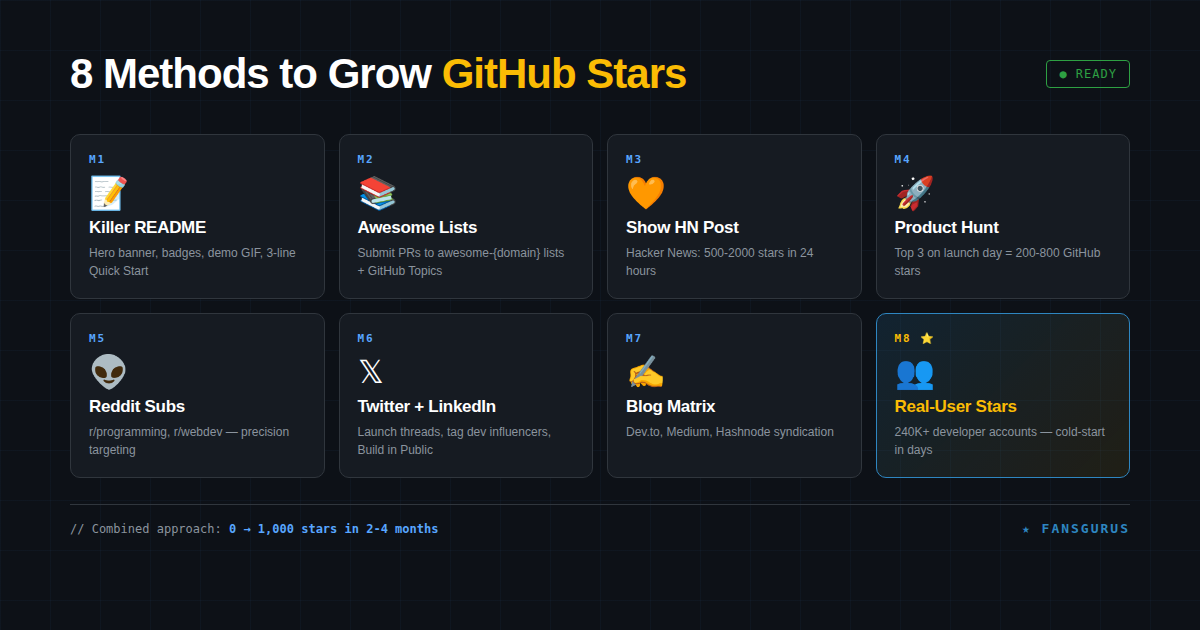
2. Method One: Build a README That Actually Sells
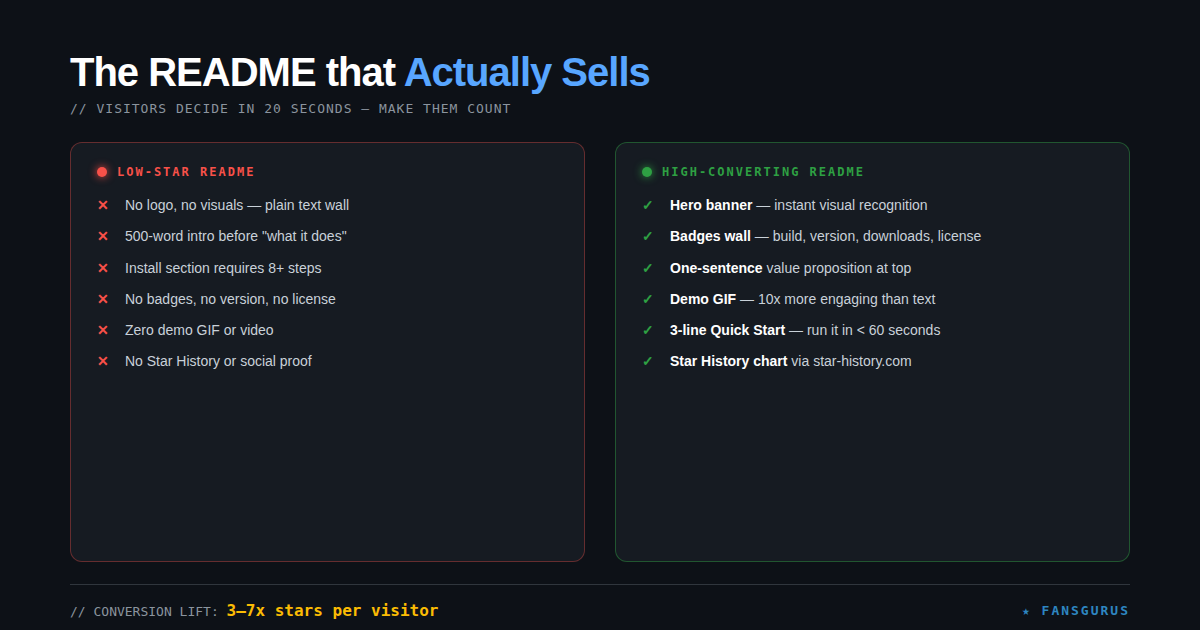
Your README is the landing page for your repo. Visitors decide whether to star you within 20 seconds of loading the page. Most zero-star projects fail here, not in the code.
A high-converting README includes: a hero image or logo banner at the top — visitors know what this is within 3 seconds; a wall of badges (build status, version, downloads, license) — they manufacture instant professionalism; one-sentence value proposition — skip the long-form pitch and tell me what problem this solves; a GIF or short video demo — worth 10x more than text; a 3-line Quick Start — if I can't run it in under a minute, I won't star it; a star history chart via star-history.com — momentum signals to visitors that others are already on board.
One underrated trick: add a "Tweet this" button next to the README title. The click-through rate is modest, but each share is free distribution pointed at a developer audience already warm to your topic.
3. Method Two: Submit to Awesome Lists
Awesome Lists are a peculiar corner of the GitHub ecosystem — community-curated compilations of "the best projects in X domain." The biggest Awesome Lists have 100,000+ stars of their own. Getting included means borrowing their long-tail traffic forever.
The process: search awesome-[your-domain] — awesome-react, awesome-python, awesome-rust, etc. — find 5-10 lists relevant to your project and submit a PR following each one's Contributing guidelines. Critical nuance: have a friend or early user submit for you, not yourself. Many list maintainers reject self-submissions by project authors but welcome third-party recommendations.
Parallel action: add 5-10 relevant Topics to your repo in Settings. When developers search those topics on GitHub, your repo appears in results. Both moves take 30 minutes total and compound for years.
4. Method Three: Post on Hacker News with "Show HN"
Hacker News is the highest-quality developer traffic source on the internet. A successful Show HN post drives 500 to 2,000 stars within 24 hours. But HN is also the most unforgiving platform — a weak title, bad timing, or low karma account gets buried before anyone sees it.
Execution playbook: title format — must start with "Show HN: ", keep the project name short, followed by a one-line description (e.g., "Show HN: Preevy – Instantly preview every Git commit"). Timing — US Eastern Tuesday-Thursday, 8 to 10 AM is the proven window. First comment — the author posts a detailed comment explaining "why we built this," "what problem it solves," and "the tech stack" as the first reply, pinning context. Response discipline — HN readers ask sharp, skeptical questions. Reply technically and honestly. Any marketing tone gets downvoted into oblivion.
"Our open source project Preevy hit 1,500+ stars within 48 hours of the Show HN post. It was the single highest-ROI promotion action we ran." — Preevy team public retrospective
5. Method Four: Launch on Product Hunt
Product Hunt skews more toward product users than pure developers, but it's a major exposure channel for open source projects — especially those with a SaaS commercial layer planned. Landing in the top 3 on launch day delivers 1,000-3,000 visits, converting to 200-800 GitHub stars.
Keys to a successful launch: prepare your asset pack in advance — logo, 5+ product screenshots, 30-second demo video, tight value proposition. Pick your launch day — Tuesday through Thursday is ideal; avoid Monday (low traffic) and weekends (high competition). Have a "Hunter" submit you — a well-known Hunter account drives initial momentum you can't generate yourself. Hustle on launch day — reply to every comment within an hour all day; engagement velocity drives ranking. Mobilize early supporters — tell everyone who ever used your project the launch date in advance and ask them to upvote on the day.
Reddit has dozens of active developer subreddits, each a concentrated pool of potential users. r/programming (4M members), r/webdev (2M), r/javascript, r/Python, r/golang, r/rust, r/opensource — developers in these subs debate tool choices daily.
Reddit is stricter than HN about self-promotion: don't drop naked project links — most tech subs ban self-promo posts; you'll get deleted or shadowbanned. Package it as a "journey" post — retitle as "I built X because Y — here's what I learned," with the GitHub link buried in the post body. Warm up the account first — spend 2-3 weeks participating in the target subs and building karma before your promotional post. Stagger across subs — never post the same project to multiple subs on the same day; space them 3-5 days apart to avoid spam flags.
X is where developer attention compounds. Projects routinely jump from a few hundred to tens of thousands of stars because one well-followed developer quote-tweeted the repo. LinkedIn skews more B2B and enterprise-friendly — the right platform for DevTools, data infrastructure, and enterprise SaaS.
Concrete tactics: write a launch thread on X — short video or GIF + GitHub link + core value prop, and tag 3-5 well-followed developers in your domain inviting their feedback. Jump on trending topics — when a new framework or language feature trends, write "here's how to use [your tool] with [trending topic]." Build in public weekly — post progress updates every week; your audience sees a living project, not a dead repo. Publish LinkedIn long-form — a thoughtful "why I open-sourced X" article gets strong algorithmic push on LinkedIn.
Public 2025 data from DevRel consultancies: a 10K-follower developer account endorsing your project on X typically drives 300-800 GitHub stars per post.
8. Method Seven: Technical Blog Content Distribution
A single blog post delivers maybe 20-50 stars. But syndicate the same post across a matrix of platforms and the cumulative return compounds fast. Open source tools like multiple open source projects that use Fansgurus growth services have used this matrix approach to hit 1,000+ stars in under 6 months, often paired with early-stage real-user star seeding.
Recommended technical blog matrix: international platforms — Dev.to (highest dev concentration), Hashnode, HackerNoon, Medium (publishing through freeCodeCamp channels borrows their audience). Niche platforms — Smashing Magazine for frontend, Towards Data Science for ML/AI, Hugging Face blog for AI models, CSS-Tricks for CSS work.
The writing move that works: "how we built X" narrative posts outperform pure tutorial posts by a wide margin. Readers develop a parasocial interest in the author, then visit and star the GitHub repo as a thank-you.
9. Method Eight: Professional Real-User Star Services for Cold-Start Acceleration
Methods 1 through 7 all work — but they share one drawback. They're slow. A project that needs impact during a finite launch window (a funding round, a hiring push, a product-market fit sprint) can't afford 3-6 months of patient community building. This is where method 8 becomes pragmatic: using a professional real-user GitHub star service to inject initial momentum during the cold-start phase.
One critical distinction up front: not every "buy stars" path is the same thing. The market does contain bot-generated fake stars — a 2025 study by Socket Inc and Carnegie Mellon identified 4.5 million fake stars on GitHub since 2024, nearly all traced to accounts with no avatar, no personal repos, no commit history, and no followers. GitHub's risk engine detects and purges these accounts, and repos that rely on them end up worse off than before. Stars delivered by real developer accounts are a categorically different product. These stars come from real GitHub users with normal usage history, their own repos, followers, and contribution graphs. The data signature is indistinguishable from organic growth because it is, mechanically, organic — a real human with a real account clicked the star button.
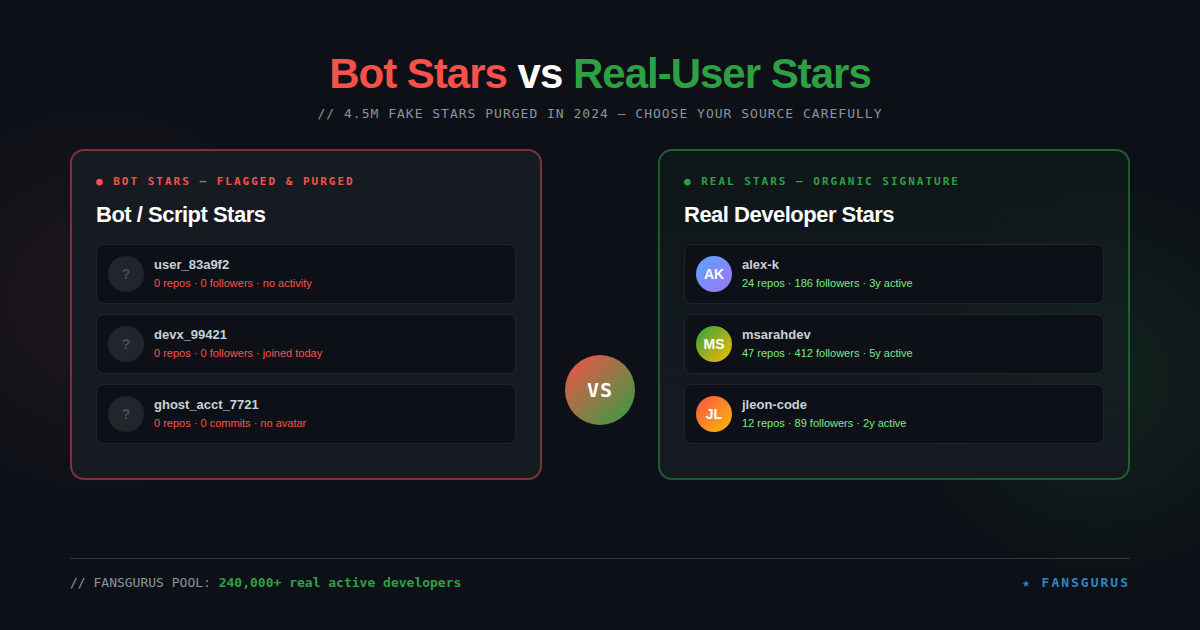
This is exactly what Fansgurus' real-user GitHub star service delivers. The Fansgurus platform operates a community of 240,000+ real, registered developers. Every star is completed manually by one of these developers using their own active GitHub account, in exchange for platform-paid task compensation. The social proof from real accounts is something bot stars can never replicate: anyone can click through the Stargazers list and verify each account directly — every profile has an avatar, personal repos, a commit history, followers, and follow relationships.
Three Scenarios Where Real-User Stars Fit Best
Scenario 1: Launch-day cold start. A freshly-published open source project at 0 stars faces a chicken-and-egg problem — no one wants to be the first user. Injecting 100-500 real initial stars during launch week signals "others are already using this," and dramatically lifts conversion rates on subsequent organic traffic.
Scenario 2: Hitting GitHub Trending. Trending is a velocity-weighted list, not a total-stars list. A project that picks up 50-200 stars within a 24-48 hour window enters the language-specific Trending page. Once on Trending, organic developer traffic adds another 300-1,000 stars daily — creating the compound effect that makes projects go viral.
Scenario 3: Pre-funding or BD data optimization. Solo developers and small teams pitching VCs or enterprise customers face a brutal truth: star count is the fastest proxy for technical influence. Sprinting toward a round number (1K, 5K, 10K) before a key meeting is a widely-acknowledged practice among commercial open source teams, and real-user services are the clean way to do it.
10. How to Combine the 8 Methods Into One Campaign
These methods aren't substitutes for each other — they compound when layered properly. A reference timeline used by many successful open source launches:
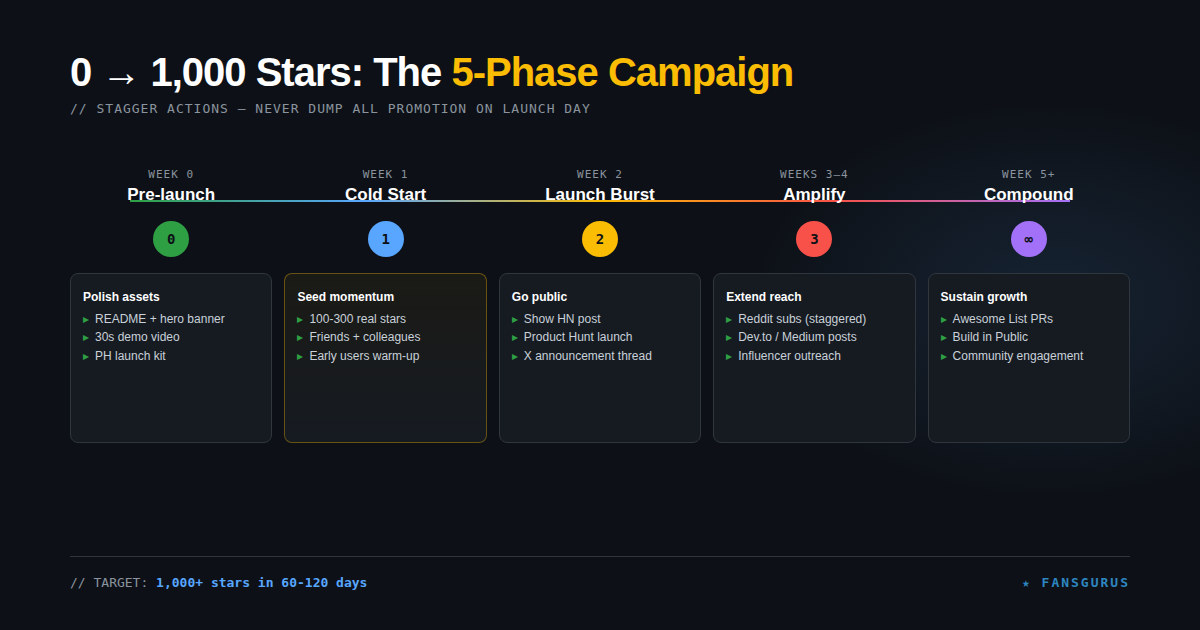
| Phase | Week | Core Actions |
|---|
| Pre-launch | Week 0 | Polish README, record demo video, prep Product Hunt assets |
| Cold start | Week 1 | Seed 100-300 real stars via Fansgurus, mobilize friends and early users |
| Launch burst | Week 2 | Show HN post, Product Hunt launch, X announcement thread |
| Amplification | Weeks 3-4 | Reddit subreddit posts, Dev.to/Medium article distribution |
| Compounding | Week 5+ | Awesome List submissions, Build in Public updates, community engagement |
The common mistake is cramming all promotion actions into launch day. The result: traffic spikes, the author can't respond to everyone, big accounts miss the window, momentum stalls. Staggering actions across weeks lets each channel reach full saturation.
11. About Fansgurus' GitHub Real-User Services
Founded in 2018, Fansgurus is a specialized social media and developer-community growth platform serving customers across 15+ major platforms — GitHub, Twitter/X, Instagram, TikTok, YouTube, Telegram, and more. In the GitHub category, Fansgurus offers three core services: real-user GitHub Stars, real-user GitHub Followers, and real-user GitHub Forks. All delivery is handled manually by the platform's 240,000+ real active developer community — no scripts, no bots, no fake accounts.
For open source maintainers and growth teams, Fansgurus offers flexible packages ranging from a 50-star test package to 10,000+ star long-term drip-feed campaigns. Delivery uses a drip-feed model that grows stars gradually over days or weeks, matching the curve of organic viral growth exactly. Every order includes a 30-day refill guarantee — if any delivered star drops due to platform clean-up, Fansgurus replaces it at no charge. Specific pricing and package details are available at the Fansgurus GitHub real-user service page.
12. Frequently Asked Questions
Why do GitHub stars actually matter for an open source project?
Stars drive three outcomes: they signal credibility to developers evaluating your project, they feed GitHub's search and Trending algorithms as a velocity input, and they function as hiring and funding leverage for independent developers and teams. Based on Fansgurus client retrospectives, a project that grows from 100 to 1,000 stars typically sees 8-15x higher daily organic traffic because stars compound into algorithmic visibility.
How can a brand new project get its first 100 GitHub stars fast?
Three effective cold-start paths: mobilize developer friends and colleagues for 20-50 stars, run a well-crafted Show HN post for 200-500 stars, or use a real-user star service to inject initial momentum. Fansgurus' GitHub real-user service offers a 50-star starter package specifically for solo developers who need to cross the cold-start threshold quickly on a tight budget.
Is it safe to buy GitHub stars? Will it affect my project?
The answer depends entirely on whether the stars come from real accounts or bots. Bot-generated stars get detected and purged by GitHub's risk engine, damaging the project. Stars from real developer accounts, however, are indistinguishable from organic growth because they are organic — a real human clicks the star button from their real account. Fansgurus has been serving open source projects for 8+ years with zero documented cases of real-user star delivery causing account flags or data anomalies.
How do I get on GitHub Trending? How many stars does it take?
GitHub Trending ranks by star velocity, not total star count. Picking up 50-100 stars in a 24-hour window typically lands a project on its language-specific Trending page; the all-languages daily Trending list requires 200+ stars in 24 hours. Because the velocity window is so tight, many teams pair organic launch efforts with Fansgurus' concentrated real-user star delivery to guarantee enough momentum during the critical window.
What's the difference between real GitHub stars and bot stars?
The difference is whether the account behind each star is genuine. Bot accounts typically lack avatars, personal repositories, commit history, and followers — characteristics GitHub's detection systems flag for mass removal. Real stars come from developers actively using GitHub day-to-day, complete with avatars, repos, contribution graphs, and follower relationships. You can verify this directly by clicking into the Stargazers list. Fansgurus' 240,000+ real-user pool spans developers from multiple countries worldwide.
What GitHub real-user growth services does Fansgurus offer?
Fansgurus' GitHub service menu covers real-user GitHub Stars (repo likes), real-user GitHub Followers (account followers), and real-user GitHub Forks (repo clones) — all delivered manually by 240,000+ verified active developer accounts. Orders support drip-feed delivery with configurable daily pacing, so data growth curves mirror organic viral growth. Packages range from 50-star starter to 10,000+ star long-term campaigns, and every order includes a 30-day refill guarantee. Full pricing and package details at the Fansgurus GitHub service page.
13. Final Word: The Long Game of GitHub Growth
Growing GitHub stars isn't a hack problem — it's a persistence problem. The project itself is the foundation. Promotion is the accelerator. Neither replaces the other. A project that doesn't solve a real problem will regress no matter how hard you promote it. But a solid project paired with the right promotion stack usually crosses 1K stars within 2-4 months.
For teams operating under launch-window pressure, real-user star services are a pragmatic tool in the stack. It's not fabrication — it's filling the "social proof gap" during the cold-start phase, the same way restaurants host soft-launch preview nights or publishers run pre-sale campaigns. You compress the 3-6 months of organic accumulation needed for the first 500 stars into 2-4 weeks, buying real product value the chance to be seen. Explore the specific packages at Fansgurus GitHub real-user services.