You post consistently. You have followers. But over the last few months, your posts just disappear—views have crashed from thousands to hundreds, comments are sparse. You're not alone. According to Richard van der Blom's 2026 LinkedIn Algorithm Report, average reach has permanently reset to a lower baseline. But here's what most "LinkedIn is broken" articles miss: some accounts aren't just recovering their reach, they're exceeding last year's numbers. The difference isn't effort. It's understanding the rules that actually work in 2026.
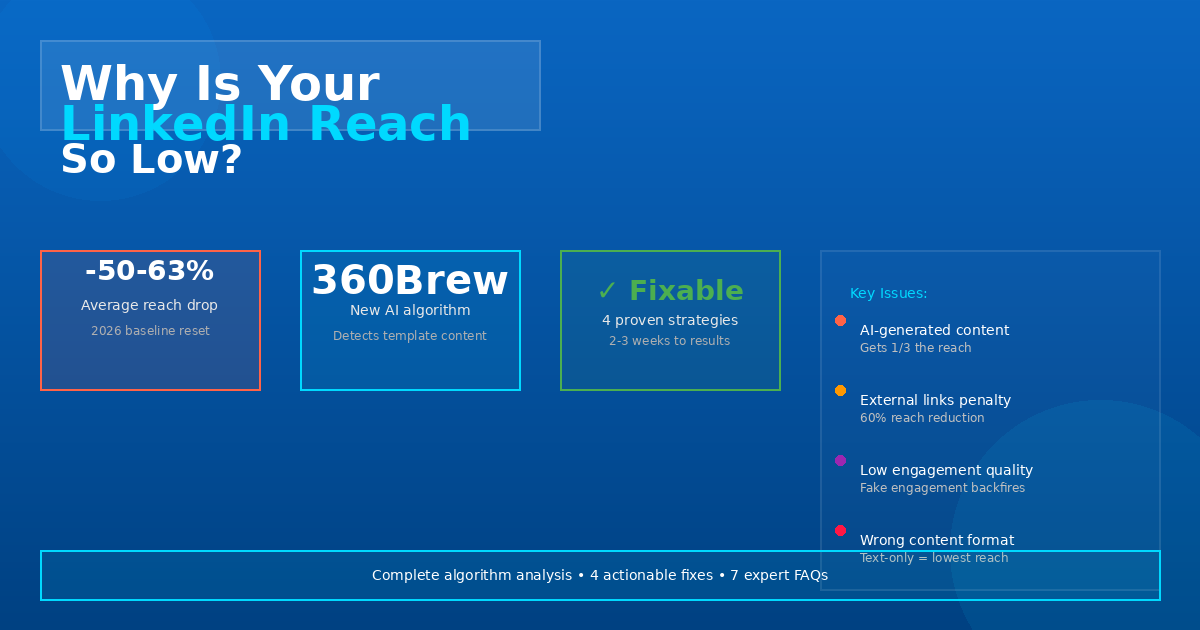
Why Is Your LinkedIn Reach So Low? Understanding the 2026 Feed Algorithm
Fansgurus Yazarı
·
oluşturuldu:2026-06-22 03:10:05
·
güncellendi:2026-06-22 06:36:00
1. The Core Problem: Your Network No Longer Determines Your Reach
LinkedIn didn't just tweak its algorithm. It fundamentally rewrote the distribution system.
How LinkedIn worked before: The platform showed you content from people in your network. If you had 20,000 first-degree connections, a predictable percentage would see your posts simply because you were connected. Network size = reach.
How LinkedIn works now: In early 2026, the platform completed a transition from a Relationship Graph (who you know) to an Interest Graph (what you're interested in). Your post about sales strategies won't automatically go to your 1,000 connections. It goes to whoever LinkedIn's AI thinks is interested in sales content—whether they know you or not.
The impact is brutal for unprepared accounts. Reach can drop 50-63% overnight. But it's also created a massive opportunity for accounts that adapt.
2. Why Your Reach Collapsed: 5 Core Reasons
Reason 1: LinkedIn's AI Can Detect Your Content, And It's Not Impressed
LinkedIn deployed a new AI evaluation system called "360Brew" in 2026. Here's what it does: it doesn't just measure engagement metrics. It evaluates whether your content is authentic, expert-level, and original—or whether it's templated, AI-generated, or low-effort.
How does it detect AI content? Not by analyzing linguistic patterns (that's easy to fool). Instead, it uses pattern recognition at scale:
- Repetitive sentence structures: If your post uses the same opening formula, the same "here's 5 reasons why," the same closing call-to-action as thousands of other posts, the system flags it
- Overly polished grammar with zero personality: Real human writing has quirks, contractions, sometimes errors. AI writing is perfectly grammatical and perfectly boring
- Generic advice with no specific examples: ChatGPT outputs tend toward broad generalities. Real expertise is demonstrated through specific client names, actual project details, concrete failures you've learned from
The penalty is severe. Research shows AI-generated or template-style content gets roughly 1/3 the reach of original, authentic content.
Reason 2: Engagement Quality, Not Just Quantity
Here's the trap: you might think "just post more often to get more engagement signals."
Wrong. LinkedIn now distinguishes between surface-level engagement and meaningful engagement.
- Dwell time matters: A user who spends 5 seconds clicking your like is not the same as a user who reads your full post for 30 seconds. The system measures how long people actually spend on your content
- Comment substance matters: "Love this!" vs. "I disagree with point X, but in my experience…"—these generate different quality signals
- Saves and reposts beat likes: When someone saves your post (bookmarks it), the algorithm interprets it as "this is valuable enough to keep." When someone reposts it, the system weighs that heavily. Quick likes? Less valuable
The underlying logic is straightforward: LinkedIn can now distinguish fake engagement (mindless scrolling) from genuine engagement (someone actually found value). The algorithm rewards the latter.
Reason 3: External Links Are Destroying Your Reach
This one surprises everyone.
Research data is clear: adding one external link to a post reduces reach by approximately 60%. A post that would normally get 10,000 impressions drops to 4,000.
Why the penalty? Because LinkedIn wants people to stay on LinkedIn. Links redirect traffic away from the platform. The algorithm actively punishes behavior that leaks users offsite.
You've probably heard the workaround: "put the link in the first comment." This helps, but it's not perfect. Studies show links in comments still reduce reach by 20-40%.
The practical takeaway: If that external link drives high-value conversions (genuine sales leads, for example), the 60% reach loss might be worth it. But if you're just driving generic traffic? Reconsider whether the link is necessary.
Reason 4: You're Publishing at the Wrong Time (And Not Understanding Why)
The old advice was "post weekdays 9-11 AM for maximum reach."
That's still partly true, but it's incomplete. The real principle: publish based on your audience's timezone.
If your target clients are in Europe, and you post at 11 PM China time, that content hits their evening or bedtime window. Initial engagement is low. 360Brew interprets low early engagement as a signal that the post isn't valuable. The algorithm throttles distribution. You just sabotaged your own reach.
There's another dimension: consistency. If you post Monday, Wednesday, Friday—the algorithm sees you as active and allocates more early-stage distribution. If you post 4 times in one week, then disappear for two weeks, the system flags you as erratic or inactive.
Reason 5: You're Using the Wrong Content Format
Performance metrics vary wildly by format on 2026 LinkedIn:
| Content Format | Engagement Rate | Rank |
|---|---|---|
| Document carousels | 6.6% | ✅ Highest |
| Natively uploaded video | 2-5% | ✅ Second |
| Embedded video (YouTube links) | Same as video, but with link penalty | ⚠️ Penalized |
| Text-only posts | 0.5-2% | ❌ Lowest |
Why the massive variance? Because dwell time differs. Users spend more time interacting with documents and videos. The algorithm rewards content that keeps users engaged.
If you've been posting primarily text-only, you've been operating with one hand tied behind your back.
3. The 5 Most Overlooked "Reach Killers"
Killer 1: The Hashtag Reversal
What used to work: 10-15 hashtags per post to increase searchability.
What actually works now: Posts without hashtags outperform posts with hashtags by 5-10%.
Why? LinkedIn removed the "follow hashtag" feature years ago and eliminated hashtag fields from user profiles. The system now uses NLP (natural language processing) to understand post content. It no longer relies on hashtags for topic classification.
New rule of thumb: Use 0-3 hashtags. Only use them if there's a truly relevant, high-value hashtag worth including.
Killer 2: Engagement Pods Are Now a Shadowban Risk
If you're still using Lempod or other engagement pods, stop now.
What changed: 360Brew detects manipulation patterns. When the same group of accounts constantly engages with each other's posts in coordinated ways, the system flags it. The punishment isn't a permanent ban—it's a "shadowban." Your posts still publish, but reach crashes from thousands to hundreds. And your account trust score drops.
How bad? Users report reaching "hundreds" instead of "thousands" after being flagged. Some accounts see their reach practically disappear.
Killer 3: "Post and Ghost" Penalty
Here's a new punishment mechanism: If you publish a post and then disappear—don't check comments, don't engage for hours—360Brew detects this pattern.
The algorithm's interpretation: you're not committed to this content. It's probably low-value.
By contrast, accounts that publish and then spend 1-2 hours actively responding to comments and participating in discussion get more early-stage distribution boost.
Best practice: Spend the first 2 hours after posting actively engaging with comments. This sends the signal "this content matters to me."
Killer 4: Lack of Topic Authority Signals
LinkedIn introduced "Topic Authority" in 2026. Here's the concept: If you claim to be a "sales expert" but your posts mix sales, operations, marketing, and product strategy, the system recognizes you lack focus.
By contrast, if your profile headline says "Sales," your recent posts are about sales, the discussions you participate in are sales-focused, and your experience history aligns with sales—you get a Topic Authority boost.
How does the system check? By analyzing your profile headline, recent post topics, which posts you comment on, your experience history, and consistency between all these signals.
Killer 5: Using Tactics That Worked in 2023 (And Are Now Dead)
- LinkedIn Polls: Once a growth hack, now averaging 0.07% engagement. The system classifies polls as low-effort engagement bait
- Fake followers/engagement: Your follower count looks bigger, but these accounts pollute your early engagement signals. The algorithm misreads your audience, and your actual reach and conversion rates typically decline
4. 4 Actionable Fixes You Can Implement This Week
Fix 1: Audit Your Content for Topic Authority
Spend one hour analyzing your last 20 posts. Do they revolve around a single topic? Or do they scatter across 5+ different subjects? Does your profile headline match the content you've been posting?
Action: Choose one domain where you have genuine, deep expertise. Make 80% of your posts focused on this topic for the next 4-6 weeks. You don't have to abandon other topics entirely—but establish a clear main thread.
Fix 2: Shift Your Content Format Mix
If you're currently 80% text-only, change immediately:
- This week: Publish at least 1 document or carousel post
- Next week: Publish at least 1 natively uploaded video (not a YouTube link)
- Ongoing: Keep text-only to 20-30%. Make 70-80% documents, videos, or mixed-media
Fix 3: Create a "20-Minute Engagement Window"
After publishing, spend the next 20 minutes actively responding to comments. Don't just say "Great point!" or "Thanks!" Provide substantive replies:
- ❌ Weak: "Love this!"
- ✅ Strong: "I agree with X. In my experience, there's also a Y variable that often gets overlooked. Have you seen that pattern with your clients too?"
Fix 4: Remove External Links (Unless Absolutely Necessary)
If you must include a link: Put it in the first comment, not the post body. Use a clear CTA: "Want the full guide? Link is in the comments." Only do this if the link genuinely drives high-value conversions.
If you don't need the link: Don't include it. Your reach will be 60% higher without it.
5. FAQ: Common Questions About LinkedIn Reach
Frequently Asked Questions
Q1: I'm doing everything you mentioned. When will I see results?
A: LinkedIn gives new content strategies roughly 2-3 weeks to prove themselves. The system needs enough data (typically 5-8 high-quality posts) to reassess your account trustworthiness and content quality. After 2-3 weeks of consistent improvements, you should see measurable reach increases. If you don't, there may be other factors requiring deeper diagnosis. Consider Fansgurus' LinkedIn real-user growth service to help accelerate initial momentum during the critical growth phase.
Q2: I'm using a company page, not a personal profile. Are the rules the same?
A: Mostly yes, with one critical difference: personal account content gets about 2x the engagement of company pages. This is by design—LinkedIn prioritizes personal voices. If you're running a company page, you need higher content quality to achieve equivalent reach. Ideally, have company representatives also post personally for better visibility.
Q3: I'm brand new. My reach is already terrible. What should I do differently?
A: New accounts go through a "warmup period." LinkedIn watches new registrations carefully to prevent bot abuse. Recommendations: Weekly activity increases shouldn't exceed 10-15%, build account credibility through high-quality interactions first (thoughtful comments, meaningful engagement), and avoid any risky behavior in the first 2 weeks (mass connecting, frequent posting, etc.).
Q4: LinkedIn says they "prioritize authentic, expert-level content." How do I demonstrate expertise?
A: The system doesn't check for credentials or certifications. It evaluates: specific real cases with numbers and results, industry-specific language showing real-world experience, and current trend analysis. Simple test: Could anyone (or any AI) write what you just wrote? Or is it uniquely yours? If it's uniquely yours, you're signaling expertise.
Q5: My competitor uses engagement pods and gets higher reach. Is that not unfair?
A: Short-term, yes, they might look ahead. But 360Brew's punishment for engagement pods is often delayed. Some violating accounts haven't been downranked yet. When LinkedIn runs its periodic cleanup sweeps, these accounts see dramatic reach crashes (from thousands to hundreds). Long-term, this isn't sustainable.
Q6: Can I build topic authority in two different domains simultaneously?
A: Technically yes, but it requires careful separation. If you're both a "sales expert" and "marketing expert," don't mix them in one post. Instead: Post about sales Monday, Wednesday, Friday. Post about marketing Tuesday, Thursday. Maintain this pattern for 4-6 weeks. Honest answer: Single expertise is stronger. The algorithm preferentially recommends highly focused accounts.
Q7: I think I'm shadowbanned. How do I tell, and how do I recover?
A: Signs of shadowban: New post reach dropped 80%+ from your historical average, almost zero non-follower reach (90%+ comes from people already following you), your posts disappear from recommendation feeds and topic pages. Recovery process: Immediately stop suspicious activity (pods, rapid engagement, frequent posting), post 2 weeks of high-quality original content, spend 30 minutes daily on genuine social interaction, avoid promotional language. After 2-3 weeks, the restriction typically lifts.
6. Summary: 3 Things You Can Change Today
Right now:
- Review your last 10 posts. How many are text-only? Convert at least one to a document or video.
- Check your hashtags. If you're using more than 3, delete the extras.
- Remember the 20-minute window. Next time you post, actively engage for 20 minutes.
This week:
- Identify your "topic focus"—the one domain where you have the most genuine expertise
- Make sure your profile headline and recent posts align
- If you're using engagement pods, stop immediately and wait 2-3 weeks for system reassessment
Be patient: LinkedIn's algorithm doesn't change overnight. But if you start adjusting now, you should see measurable reach improvement within 2-3 weeks. Early adopters of these strategies are already seeing reach rebound—sometimes exceeding last year's numbers.
7. About Fansgurus
As you work on improving your LinkedIn reach, remember: this is fundamentally about demonstrating authentic expertise and building real professional relationships.
For creators and businesses facing specific challenges like cold-start accounts, recovering from historical restrictions, or needing rapid social proof signals during growth phases, Fansgurus offers LinkedIn real-user growth services that can help accelerate initial momentum.
But your core strategy should remain: focus on content, maintain vertical consistency, build authority, and earn genuine engagement. These are entirely achievable on your own.
Keep optimizing. The next 2-3 weeks will show you the difference.