Buy Verified Trustpilot Reviews vs Organic Invites: What's Safer for Your TrustScore?
Fansgurus Editorial Team
·
created at:2026-07-27 07:13:42
·
updated at:2026-07-27 07:13:42
article keywords tips:
#buy verified trustpilot reviews
#verified vs organic trustpilot
#trustpilot review invitations
#trustpilot verified badge
#buy trustpilot reviews
#trustpilot trustscore safe
Short answer: neither route is safe or unsafe by itself — safety is decided by three execution variables: the invitation path, the age of the reviewing account, and the delivery pace. Organic invitations sent from your own Trustpilot account are the lowest-risk base layer and you should always run them, but they hit two hard ceilings: your plan's monthly invitation quota (Free 50, Starter 100, Plus 300, Premium 1,000) and your actual order volume. Buying verified reviews removes the volume ceiling but only stays on your profile if it runs through Trustpilot's official invitation flow, from long-standing accounts, at a paced rate. Fansgurus service 16341 is $8.5 per review on that path.
This article compares the two routes the way a merchant actually has to decide between them: what Trustpilot's own labels mean, what each route really costs per published review once you divide by response rate, why organic invitations mathematically cannot solve a cold start, and how to combine both into one 90-day plan. Every number below is either from Trustpilot's own documentation or pulled live from the Trustpilot service page in July 2026.
1. What is actually the difference between a "Verified" review and an organic one?
Trustpilot labels reviews by how the review was started, not by how good it is. There are three states worth knowing:
Organic — the customer found your profile on Trustpilot and wrote a review on their own, with no invitation. Trustpilot has no transaction record tying that person to you.
Invited — you used a Trustpilot invitation method (Automatic Feedback Service, file upload, business generated links, the Invitation Link API, or the in-app collector) to ask the customer.
Verified — an invited review that Trustpilot could link to a confirmed transaction, because you supplied the customer's name and email through Trustpilot's system. This is the one that carries the badge readers actually notice.
The label matters for three concrete reasons:
Google Seller Ratings only counts reviews collected through an approved first-party flow. Organic reviews written spontaneously on your Trustpilot page do not build toward that gate the way invited ones do.
Verification status is one of the weighting inputs in the TrustScore calculation. We broke the full weighting model down in the Trustpilot rating algorithm guide — verified reviews behave more stably in the score than uninvited ones.
Uninvited reviews get scrutinised harder. Trustpilot cannot confirm a transaction happened, so its detection layer treats an unexplained cluster of them as a stronger anomaly signal.
One correction to a common misreading: "verified" is not a synonym for "paid". A verified review is simply an invited review with a matched transaction. That is why the route you buy through matters more than the fact you bought.
2. Which route is safer? Start with Trustpilot's own removal numbers
Trustpilot publishes what it removes, and the numbers are the most useful safety input you have.
Metric (Trustpilot Trust Report)
2023
2024
Fake reviews removed
3.3 million
4.5 million
Share of all reviews submitted that year
6.1%
7.4%
Removed automatically by detection tech
—
90% (53% more than 2023)
Two details inside that report change how you should plan. First, the detection layer runs on machine learning, neural networks and generative AI — it looks for patterns, not for a confession. Second, in 2024 Trustpilot shipped technology specifically designed to find evidence that a review had been purchased. Any plan built on "they will not notice" is planning against a system that got 53% better at automatic removal in a single year.
The three things that get merchants flagged on the "safe" organic route
Here is the part most comparison articles skip. Trustpilot's Guidelines for Businesses (February 2026 edition) require you to invite consistently and fairly. Three habits that merchants genuinely believe are harmless all violate that:
Gating / cherry-picking. Sending invitations only to customers you already know are happy — for example, surveying first and inviting only the 9s and 10s. The guidelines explicitly prohibit "picking and choosing which customers you invite."
Incentives. A discount code, a prize draw entry, free shipping, or a refund in exchange for a review. Prohibited, even when the reviewer is a genuine customer and the review is honest.
Backlog dumping. Uploading twelve months of customer emails on day one. The invitations are legitimate; the resulting spike is exactly the anomaly shape the detection layer is tuned for.
If Trustpilot decides you have crossed the line, the enforcement ladder is: features blocked or suspended in your business account, a Consumer Warning placed on your public profile, your TrustScore hidden, agreement terminated, and in the worst cases legal action. Notice that the profile-level penalties damage exactly the asset you were trying to build.
Conclusion of this section: "organic = safe, paid = risky" is the wrong frame. A gated, incentivised, batch-dumped organic programme is riskier than a paced, invitation-path purchase — and a burst of directly-submitted purchased reviews from new accounts is riskier than either. Judge the execution, not the label.
3. What does an organic invitation actually cost you per published review?
Merchants compare "$0 organic invites" against "$8.5 per purchased review" and stop there. That comparison is wrong, because an invitation is not a review — a percentage of invitations become reviews. The honest formula is:
Real cost per published review = (monthly plan fee ÷ monthly invitation quota) ÷ invitation response rate
Trustpilot's published plans and quotas as of July 2026:
Trustpilot plan
Price (billed annually)
Invitations / month
Cost per invitation sent
Free
$0
50
$0
Starter (businesses up to $5M revenue)
$99 / month per domain
100
$0.99
Plus
$319 / month per domain
300
$1.06
Premium
$799 / month per domain
1,000
$0.80
Enterprise
Custom quote
Unlimited
Depends on contract
All paid plans require a 12-month commitment paid up front, so the monthly figure is a floor, not a dial you can turn down in a slow month.
Now divide by response rate. Taking the Plus plan ($319/month, 300 invitations, $1.06 per invitation sent):
Invitation response rate
Reviews published / month
Real cost per review
vs $8.5 purchased
5%
15
$21.27
2.5× more expensive
10%
30
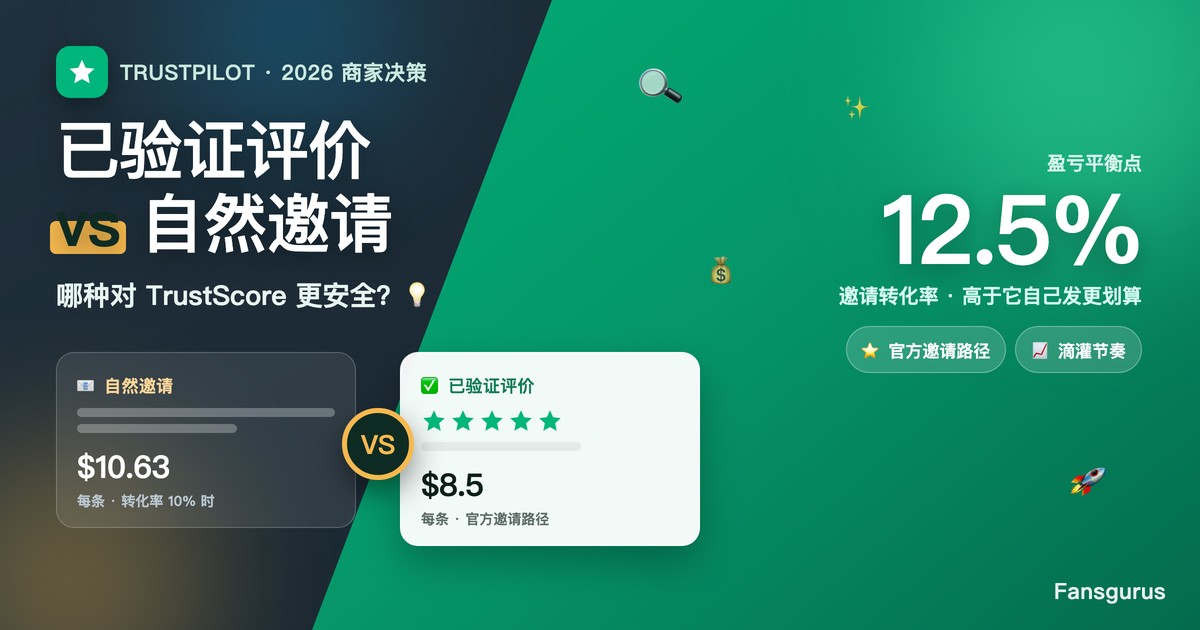
$10.63
1.25× more expensive
15%
45
$7.09
cheaper
25%
75
$4.25
half the price
Read that honestly: above roughly a 12.5% response rate, your own invitation programme is cheaper per review than buying, and it also builds a permanent asset. Below it, you are paying more for organic than for the paid route while getting fewer reviews. So before you compare providers, measure your own response rate in the Trustpilot invitation conversion dashboard — that single number decides the whole argument.
Two free levers before you spend anything
Turn on reminder emails. Trustpilot's own data puts reminders at roughly 35% more reviews collected on average. That is a response-rate increase with no incremental cost, and it can move you across the break-even line above.
Send at the right moment. Invite after delivery is confirmed, not after payment is taken. The gap between "I paid" and "I have the thing in my hand" is where negative and unanswered invitations live.
4. Why organic invitations cannot solve a cold start, no matter the budget
This is the structural argument, and it is arithmetic rather than opinion. An organic programme is capped by two ceilings at once, and you are always limited by the lower one.
Ceiling 1 — the plan quota. On the Free plan you may send 50 invitations a month, which is 600 a year. At a 10% response rate that is 60 published reviews in twelve months. Google Seller Ratings requires at least 100 unique reviews in the past 12 months and a 3.5-star average, counted per country. The free tier therefore cannot reach the Seller Ratings gate arithmetically, no matter how well you execute — you would need a sustained 17% response rate just to touch 100 in a single country.
Ceiling 2 — your order volume. You may only invite people who have had a genuine experience with your business. A store doing 200 orders a month at a 10% response rate produces 20 reviews a month. That is fine at month twelve and useless at month one, which is precisely when a shopper searching "yourbrand reviews" finds an empty profile.
Ceiling 3 — the algorithm's cold-start anchor. As covered in our TrustScore breakdown, Trustpilot seeds every new profile with a set of prior reviews around 3.5 stars before your real ones are counted. Two genuine 5-star reviews will not display as 5.0; they will land nearer 3.8–4.0. You have to accumulate enough volume to dilute that anchor before your score reflects reality at all.
Put the three together and the cold-start problem is not a budget problem or an effort problem. It is a volume-and-time problem, which is the specific gap a paced supplementary source exists to close.
5. If you do buy, where exactly does the risk sit?
Price differences across providers in this market are mostly a proxy for three execution variables. Check them in this order, because they are ordered by how much they matter.
The submission path. Does the review come from an official Trustpilot invitation email that the reviewer clicks — or is it typed straight into your public profile page? The first is the same flow your own customers use. The second has no transaction record behind it and is what the detection layer is looking for.
The account history behind each review. A newly registered email with an empty profile is the single strongest anomaly signal available. Accounts with a registered email older than six months, a completed profile and an ongoing posting history are indistinguishable from your own customers at the platform layer.
The delivery pace. Fifty reviews landing in one week on a profile that normally receives eight a month is a growth curve no organic business produces. Drip-feed pacing matched to your existing baseline is what keeps the curve inside the shape the platform expects.
Be clear-eyed about the platform's position: Trustpilot's guidelines prohibit fake reviews outright, and since 2024 it has run detection specifically aimed at purchased reviews. Nothing in this article claims otherwise. What the three variables above determine is whether reviews stay on your profile long enough to be worth buying at all — which is why the rational play is to keep your own invitation programme running as the base layer and treat any supplementary source as an accelerator with a defined window, not a replacement.
6. The Fansgurus Trustpilot service: mechanism, price and what is actually included
For readers who have decided a supplementary source fits their situation, here is the full specification, pulled live from the service page in July 2026.
Service ID
Service
Price
Core spec
16341
Trustpilot custom review
$8.5 per review
Manual invitation through Trustpilot's official email invitation system · reviewer email registered 6+ months · fully custom review content
Mapped against the three risk variables in the previous section:
Path: every review is initiated by a Trustpilot invitation email that the reviewer opens and acts on — the same flow as an invitation you send yourself.
Accounts: the system rejects newly registered accounts from taking orders. Only accounts whose registered email is older than six months, with a completed profile and an ongoing usage history, are eligible.
Pace: delivery is drip-fed and calibrated to your profile's existing review volume, so the daily rate stays inside your own baseline instead of producing a spike.
Also included: custom review content (you supply finished text, or a direction plus tone and the features you want mentioned), geo-targeting by market, multi-language review copy, and free replacement of any review removed inside the service window.
Public figures shown on the Trustpilot service page, as of the 2026-03-06 data refresh: a 4.8/5 user rating, 8 years of operation, 38,256 users in the Trustpilot execution pool and 86,432 completed tasks. If you want the service walked through end to end rather than compared, that is covered in the dedicated service guide.
7. How do you combine the two routes? A decision table and a 90-day cadence
Match your situation to the row, not to a general recommendation.
Your situation
Base layer
Supplement?
Why
New store, 0–5 reviews
Set up invitations from day one
Yes — 10–20, paced
Order volume ceiling plus the 3.5-star anchor make month one impossible on invitations alone
Response rate above 15%, score already 4.2+
Invitations + reminders
No
You are already below $8.5 per review organically; spending on top adds risk without adding speed
Stuck in the 3.x band with a large historical denominator
Fix the root cause first, then invite
Yes — staged, over months
Each step up the star ladder needs more reviews than the last; single large orders do not move a big denominator
Chasing the 100-review Google Seller Ratings gate on a deadline
Invitations at full quota
Yes — fill the shortfall only
Count is per country and per 12 months; calculate the gap and buy exactly that, not more
Recovering from a cluster of negatives
Reply publicly, use the dispute channel
Yes — dilution at a measured pace
Recency weighting means new reviews outweigh old ones, but only if the flow looks routine
A 90-day cadence you can copy
Days 1–14 — instrument first. Connect the Automatic Feedback Service so invitations fire on delivery confirmation, switch reminder emails on, and record your baseline: current review count, current TrustScore, and last month's response rate. Do not buy anything in this window; you do not yet know your gap.
Days 15–30 — measure and size the gap. With one clean month of data, compute reviews per month from invitations. Target minus organic run-rate equals the shortfall. If the shortfall is zero, stop here.
Days 31–75 — fill the shortfall at a rate your profile can absorb. A working reference: 2–3 per day for a 10–20 review gap (about a week), 3–5 per day for a 50–100 gap (three to four weeks), and 30–60 days for anything above 200. Keep organic invitations running at full quota the entire time so the paid flow is never the only thing happening.
Days 76–90 — verify and taper. Recount published reviews against what was ordered, check nothing was removed, and reduce the supplementary flow as the organic run-rate takes over. The end state is an invitation programme carrying the profile on its own.
To size the gap for your specific profile before ordering, send your Trustpilot profile URL to Telegram support (0–10 minute response) and ask for a volume and pacing plan, or configure it directly on the Trustpilot service page.
8. A seven-point check before you order anything
Do you know your current invitation response rate? If not, measure it before comparing any provider — it decides which route is cheaper for you.
Is your invitation trigger set to delivery confirmation rather than payment?
Are reminder emails switched on?
Are you inviting every customer, not only the ones you expect to be happy?
Have you removed every incentive from your review request — no codes, no draws, no refunds?
If you are buying, does the review arrive through an official Trustpilot invitation email rather than a direct submission?
Is the daily delivery rate you agreed to within the range your profile already receives organically?
If any of items 2 through 5 is unresolved, fix it before spending anything. Those four are free, they raise the response rate that drives your per-review cost, and three of them are compliance items that can cost you a Consumer Warning if left as they are.
Frequently Asked Questions
Q1: Are verified Trustpilot reviews safer than organic ones for my TrustScore?
A: Verified reviews are weighted more stably in the TrustScore calculation and are the type that feeds Google Seller Ratings, because Trustpilot can match them to a confirmed transaction. But the label alone does not make a review safe. Safety comes from three things: the review arriving through Trustpilot's official invitation flow, the reviewing account having a registered email older than six months with real posting history, and the delivery being paced against your existing review volume. A gated or incentivised organic programme can be riskier than a paced invitation-path purchase.
Q2: How many Trustpilot reviews do I need for Google Seller Ratings stars?
A: At least 100 unique reviews in the past 12 months with an average of at least 3.5 stars, counted separately for each country where your ads run. This is why Trustpilot's Free plan cannot reach the gate on its own: 50 invitations a month is 600 a year, which at a 10% response rate yields about 60 published reviews. You need either a paid plan with a larger quota, a response rate above roughly 17%, or a supplementary source to fill the shortfall.
Q3: What does a Trustpilot review really cost through invitations compared with buying?
A: Divide your plan fee by your invitation quota, then divide by your response rate. On the Plus plan at $319 a month for 300 invitations, each invitation costs $1.06, so a 5% response rate works out at $21.27 per published review, 10% at $10.63, 15% at $7.09 and 25% at $4.25. The Fansgurus Trustpilot custom review service is $8.5 per review, so the break-even sits near a 12.5% response rate. Above that, your own invitations are cheaper; below it, they are not.
Q4: Will Trustpilot remove purchased reviews?
A: Trustpilot removed 4.5 million fake reviews in 2024, equal to 7.4% of everything submitted that year, and 90% of those were caught automatically. It also runs detection built specifically to find evidence that a review was purchased. Whether a given review survives depends on the submission path, the age and activity of the account behind it, and the delivery pace — not on price. Reviews delivered through the official invitation path from long-standing accounts at a paced rate behave like ordinary invited reviews, and the Fansgurus service replaces any review removed inside the service window free of charge.
Q5: Can I run my own invitation programme and a paid service at the same time?
A: Yes, and it is the configuration we would recommend for most merchants. Your own invitations are the base layer, because they cost less per review at a healthy response rate and keep working after any campaign ends. A supplementary source covers the gap your order volume and plan quota cannot reach — a cold start, a deadline against the Seller Ratings threshold, or dilution after a cluster of negatives. What you should not do is switch your own invitations off while a paid flow runs; a profile whose only inbound reviews come from one source has a growth pattern that stands out.
📢 If you found this article helpful, feel free to share it with others: