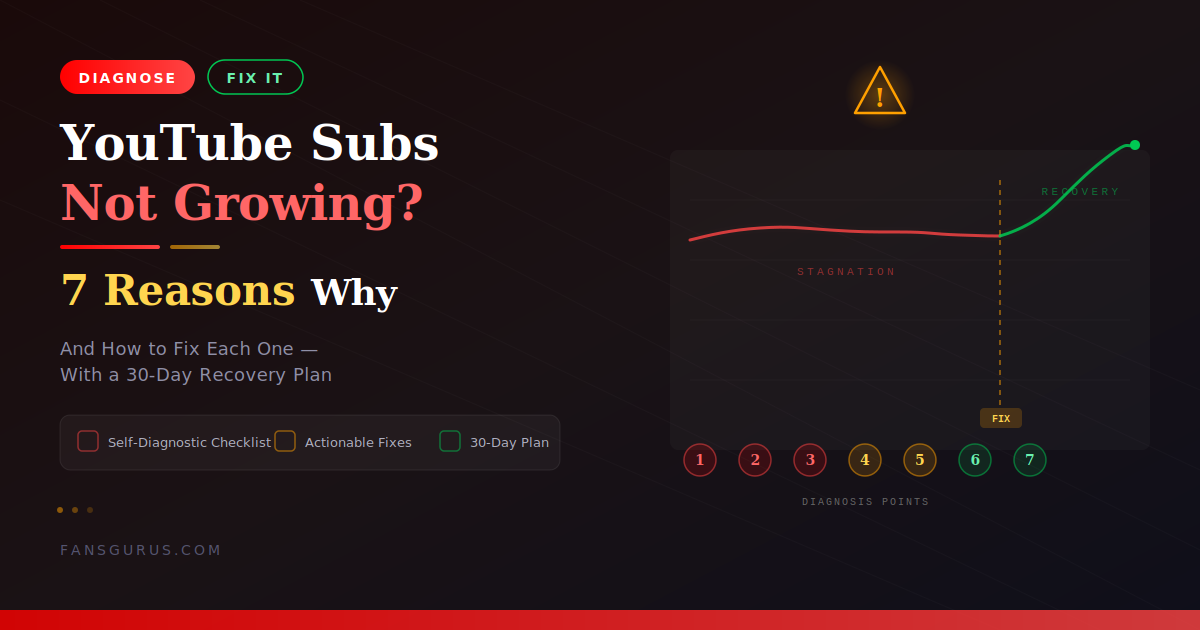
But here's the encouraging news: in almost every case, there's a specific, diagnosable reason why your channel isn't growing — and a clear fix for each one. Let's break down the 7 most common reasons your YouTube subscribers aren't increasing and what you can do about each.
一、Reason #1: You're Stuck in the "Cold Start Trap"
The Problem:
YouTube's recommendation algorithm works on a feedback loop. When you publish a video, YouTube initially shows it to a small test audience. If that audience engages (watches, likes, subscribes), YouTube shows it to more people. If not, the video gets buried.
The catch? For brand-new channels, that initial test audience is tiny — sometimes as few as 10-50 impressions. With such a small sample size, even great content struggles to generate enough engagement signals to trigger broader distribution. This is what engineers call the "cold start problem."
How to Fix It:
You need to give the algorithm a reason to take your channel seriously. There are two approaches:
- Organic approach: Share every new video across all your social media accounts, in relevant Reddit communities, Discord servers, and Facebook groups. Your goal is to manually drive the first 100-200 views to generate engagement signals.
- Accelerated approach: Build your initial subscriber base with a trusted growth service. When your channel has 1,000+ subscribers, YouTube allocates significantly more impressions to your new videos. Services like Fansgurus can provide this foundation starting at just $2.50 for 1,000 subscribers — often the most cost-effective way to break out of the cold start trap.
"I was stuck at 87 subscribers for 5 months with 30+ videos published. The algorithm was barely showing my content to anyone. After building my subscriber base to 1,200, my average video impressions jumped from 200 to over 5,000. The algorithm finally started working for me instead of against me." — Travel vlogger
二、Reason #2: Your Impressions-to-Click-Through Rate Is Too Low
The Problem:
Even when YouTube does show your videos to people, they're not clicking. Your Click-Through Rate (CTR) — the percentage of people who see your thumbnail and title and actually click — might be below the 4-5% threshold where the algorithm starts promoting content more aggressively.
A low CTR tells YouTube: "People aren't interested in this content." In response, the algorithm shows your video to fewer people, creating a downward spiral.
How to Fix It:
- Redesign your thumbnails: Use close-up facial expressions, bold contrasting colors, and minimal text (3-5 words max). Study the thumbnails of top channels in your niche.
- Rewrite your titles: Use curiosity gaps ("I Tried X for 30 Days — Here's What Happened"), numbers ("7 Mistakes That Kill Your Growth"), or urgency ("YouTube Just Changed Everything").
- A/B test ruthlessly: Use YouTube's built-in thumbnail A/B testing feature (available in Studio) to let data guide your decisions.
- Check your analytics: Go to YouTube Studio → Analytics → Content → Impressions click-through rate. If it's below 4%, thumbnail and title optimization should be your top priority.
三、Reason #3: Your Watch Time and Retention Are Killing Your Reach
The Problem:
YouTube's #1 priority is keeping viewers on the platform. If people click your video but leave within the first 30 seconds, YouTube interprets this as a signal that your content doesn't deliver on its promise. Average View Duration (AVD) and Audience Retention are arguably the most important metrics for growth.
How to Fix It:
- Hook viewers immediately: The first 15 seconds should preview the value viewers will get. Start with a bold statement, a surprising fact, or a visual hook — never with "Hey guys, welcome back to my channel."
- Use the "pattern interrupt" technique: Change camera angles, add B-roll, insert graphics, or shift your tone every 30-60 seconds to re-engage wandering attention.
- Cut ruthlessly: Every second of your video should either inform, entertain, or build anticipation. If a segment doesn't serve one of these purposes, remove it.
- Add "open loops": Tease upcoming content throughout the video: "But before we get to the most important tip, let me show you something else first..." This keeps viewers watching to the end.
- Check your retention curve: In YouTube Studio, look at Audience Retention graphs. If there's a sharp drop in the first 30 seconds, your intro needs work. If there's a gradual decline, your middle content needs more engagement hooks.
四、Reason #4: You're Not Converting Viewers Into Subscribers
The Problem:
Getting views is one thing. Converting those viewers into subscribers is another. Many channels get decent view counts but struggle with low subscriber conversion rates because they never actually ask for the subscription — or they ask in the wrong way.
How to Fix It:
- Strategic CTA placement: Don't just ask at the end. Include subscribe reminders at natural breakpoints — after delivering a particularly valuable insight, after an emotional moment, or during a transition between sections.
- Give a reason to subscribe: Instead of "Don't forget to subscribe," try "If you want a new growth strategy every Thursday, subscribe so you don't miss the next one."
- Use end screens effectively: Add subscribe buttons and "best of" video recommendations to the last 20 seconds of every video.
- Create a subscribe-worthy channel identity: Viewers subscribe to channels, not individual videos. Make it clear what type of content you consistently produce and why it's worth following.
五、Reason #5: You're Targeting the Wrong Keywords
The Problem:
If you're targeting highly competitive keywords, your videos will never rank — even if the content is excellent. Conversely, targeting keywords that nobody searches for means your videos sit in a vacuum.
How to Fix It:
- Find the sweet spot: Target keywords with moderate search volume but low competition. Use YouTube's search autocomplete to find long-tail keywords that real people are searching for.
- Check competition before filming: Search your target keyword on YouTube. If the top results are from channels with 100K+ subscribers, choose a more specific variation.
- Match search intent: If someone searches "best budget camera 2026," they want a buying guide, not a camera review. Understanding what viewers expect helps you create content that satisfies their query.
- Use data tools: Free tools like TubeBuddy and VidIQ can show you keyword search volume and competition scores to help you make informed decisions.
六、Reason #6: Your Upload Schedule Is Inconsistent
The Problem:
YouTube's algorithm rewards consistency. Channels that upload on a regular schedule get more impressions because YouTube learns to expect and promote new content from them. Sporadic uploads make it harder for the algorithm to categorize and recommend your channel.
How to Fix It:
- Pick a schedule you can maintain: One quality video per week is better than three average videos followed by two weeks of silence. Sustainability beats intensity.
- Batch produce content: Film 3-4 videos in one session and release them on schedule. This prevents production stress from disrupting your consistency.
- Communicate your schedule: Tell viewers when to expect new content — in your channel banner, video descriptions, and end-screen callouts.
- Fill gaps with Shorts: On weeks when you can't produce a full video, publish 2-3 YouTube Shorts to maintain activity on your channel.
七、Reason #7: You Don't Have Enough Social Proof
The Problem:
This is perhaps the most frustrating reason because it's largely outside your control — at least organically. When a viewer discovers your channel and sees a low subscriber count, their brain immediately makes a judgment: "If nobody else is subscribing, maybe this content isn't worth my time."
This is called "social proof bias," and it affects every aspect of human decision-making. Channels with higher subscriber counts convert new viewers at dramatically higher rates — not because the content is better, but because the numbers signal credibility.
How to Fix It:
- Build initial social proof quickly: This is where growth services become genuinely valuable. By establishing a subscriber base of 1,000-5,000 through a platform like Fansgurus, you remove the social proof barrier that prevents casual viewers from subscribing.
- Showcase engagement: If you have a strong comment section, pin the best comments. If viewers send you messages about how your content helped them, reference these testimonials in future videos.
- Highlight milestones: Even small wins (100 subscribers, 1,000 views on a video) can be celebrated to create momentum and community.
- Cross-reference credibility: Mention any external validation — media features, podcast appearances, professional credentials — that supports your authority in your niche.
八、Self-Diagnostic Checklist
Use this table to identify which issues are affecting your channel:
| Symptom |
Most Likely Cause |
Priority Fix |
| Very few impressions (under 500/video) |
Cold Start Trap (Reason #1) |
Build subscriber base + active promotion |
| Many impressions but low clicks |
Low CTR (Reason #2) |
Redesign thumbnails and titles |
| Good clicks but viewers leave fast |
Poor retention (Reason #3) |
Improve hooks and editing |
| Views are OK but subscribers don't increase |
Low conversion (Reason #4) |
Add strategic CTAs |
| Videos don't appear in search |
Wrong keywords (Reason #5) |
Research and target better keywords |
| Growth spikes then flatlines |
Inconsistency (Reason #6) |
Establish sustainable schedule |
| Good content but nobody subscribes |
Lack of social proof (Reason #7) |
Build initial subscriber base |
九、Your 30-Day Action Plan
If your channel is stuck, here's a practical 30-day plan to get things moving:
Days 1-3: Audit your channel using the diagnostic checklist above. Identify your top 2-3 issues. If social proof or cold start is a problem, consider using Fansgurus to establish a subscriber foundation.
Days 4-7: Redesign thumbnails for your top 10 videos. Update titles based on keyword research. Optimize channel page banner and description.
Days 8-14: Publish 2 new videos with improved hooks (first 15 seconds) and strategic subscribe CTAs. Launch a YouTube Shorts strategy (3-5 Shorts this week).
Days 15-21: Analyze retention curves for your new videos. Identify where viewers drop off and adjust your next video's structure accordingly.
Days 22-30: Reach out to 5 potential collaborators. Cross-promote content on 2 other social platforms. Review all metrics and refine your approach.
十、Frequently Asked Questions
How long should I wait before worrying about slow growth?
Give your channel at least 30 videos and 3 months of consistent uploading before making major strategy changes. YouTube's algorithm needs time to understand your content and audience. However, if you've published 50+ videos over 6+ months with minimal growth, there's likely a structural issue that needs addressing — don't keep doing the same thing expecting different results.
Is my YouTube channel shadowbanned?
YouTube doesn't officially "shadowban" channels, but they can limit distribution for content that borderlines community guidelines. If your impressions suddenly drop to near zero, check YouTube Studio for any policy strikes or warnings. More commonly, what feels like a shadowban is simply the algorithm not promoting your content because engagement metrics are too low.
Will buying subscribers actually fix my growth problem?
Buying subscribers addresses the cold start and social proof problems specifically. If your primary issue is poor content quality or bad retention, subscribers alone won't fix that. However, if you're creating quality content that simply isn't getting algorithmic exposure, a subscriber boost can be the catalyst that triggers real organic growth.
Should I delete my old underperforming videos?
Generally, no. Deleting videos removes any accumulated watch time and engagement data. Instead, make old videos "private" if they don't represent your current content quality. Focus your energy on creating better new content rather than cleaning up old work.
Should I change my niche if I'm not growing?
Before changing niches, make sure you've addressed all 7 reasons listed in this article. Many channels fail not because of the niche, but because of execution issues. If you've optimized everything and still aren't growing after 6+ months, then testing a different content angle within your broader topic area can make sense.