

Facebook ad costs keep climbing — CPM rates hit record highs in 2025 and show no signs of slowing down in 2026. Yet thousands of brands, e-commerce sellers, and page admins are generating consistent, targeted traffic without spending a dollar on ads. The secret isn't a hack or loophole — it's a set of underused organic strategies hiding in plain sight. This guide breaks down 5 proven Facebook free traffic methods, each with concrete execution steps, so your page stops depending entirely on boosted posts and starts building compounding organic reach that grows over time.
5 Facebook Free Traffic Methods Beyond Ads — Save $3,000/Month in Ad Spend (2026)
Fansgurus Editorial Team
·
created at:2026-03-05 09:51:00
·
updated at:2026-06-25 14:17:32
article keywords tips:
- #Facebook free traffic
- #increase Facebook organic reach
- #grow Facebook page without ads
- #how to get free traffic on Facebook 2026
- #Facebook Reels organic reach tips
1. Facebook Group Marketing: Tap Into Where Your Target Audience Already Gathers
Facebook Groups are the most underestimated free traffic source on the platform. With over 10 million active groups covering virtually every niche, industry, and interest, groups give you direct access to self-selected audiences who have raised their hand and said, "Yes, I care about this topic." According to Meta's own data, over 1.8 billion people use Facebook Groups every month — that's an audience already pre-sorted by interest, waiting to discover your brand.
How to Find Groups Where Your Target Customers Are Active
Method 1: Keyword Search
Enter product-related keywords in the Facebook search bar and filter results to "Groups." Prioritize groups with these characteristics:
- Member count between 5,000 and 500,000 (too small limits reach; massive generic groups have low engagement per member)
- High recent post frequency — check the group's activity stats shown in the sidebar
- Member-posting allowed, not restricted to admin-only content
Method 2: Competitor Reverse Research
Find competitor brand pages and click through to commenters on their posts. Visit their public profiles to see which groups they've joined. This reveals the exact communities where your target audience is already active.
Method 3: Niche Vertical Targeting
The more specific, the better. A pet supplies brand should target "French Bulldog Owners Support Group" over a generic "Pet Lovers" group. Hyper-specific groups have lower noise and higher intent. Look for groups with words like "tips," "advice," "recommendations," "review," or "help" in the name — these attract people actively seeking solutions.
The 70/20/10 Content Rule for Group Marketing
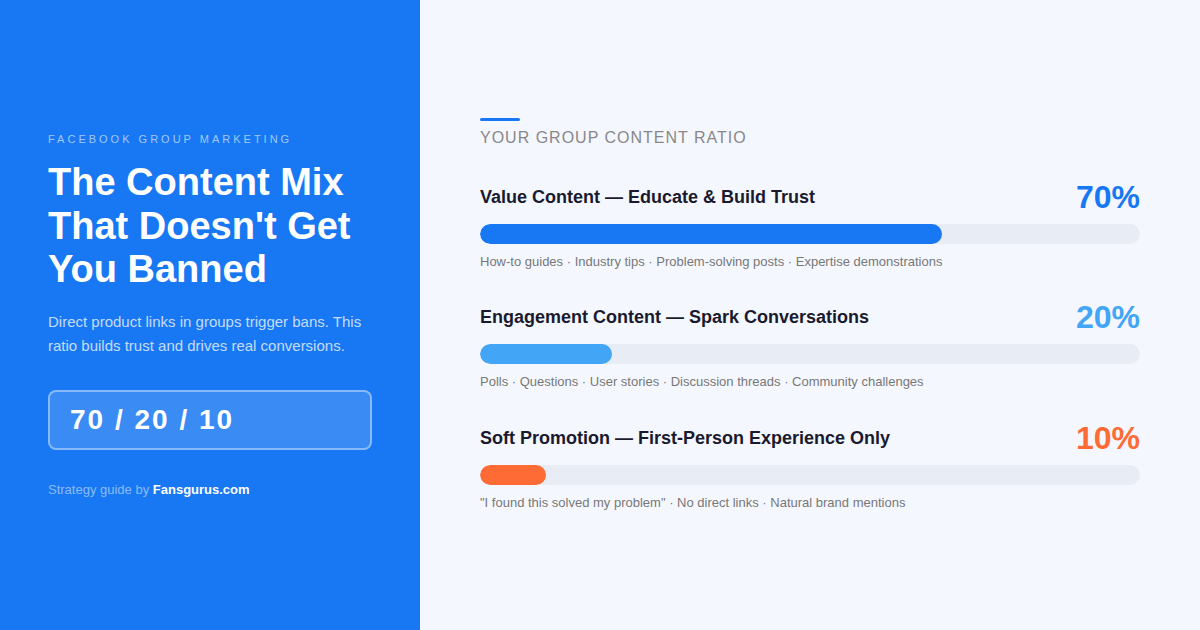
Dropping product links directly into groups is the fastest way to get banned and achieve zero results. The correct content mix is:
- 70% Value Content: Educational posts, how-to guides, industry knowledge, solutions to common pain points. This builds your reputation as a trusted expert, not a spammer.
- 20% Engagement Content: Questions, polls, user stories, discussion starters. Engagement posts boost your comment count and trigger the algorithm to show your posts to more group members.
- 10% Soft Promotion: First-person experience sharing — "I found this solved my problem" — rather than direct product links. Let curiosity pull people to your profile and page.
"Become a trusted contributor first, then talk about conversion. An account that consistently delivers value in a group creates trust that no ad copy can replicate. When that account occasionally recommends a product, members listen."
Building Your Own Group: Converting Public Traffic Into a Private Asset
Creating your own Facebook Group is the most effective way to convert cold public traffic into a warm private community. Key principles for brand-owned groups:
- Name it after the audience's identity, not your brand. A home cleaning brand should create "Natural Home Cleaning Community" instead of "BrandName User Group." People join communities built around their interests, not brand fan clubs.
- Set 3 entry questions to filter for genuine target users and collect useful data (email addresses, specific needs, where they heard about you).
- Maintain a consistent posting rhythm — at minimum 3 admin posts per week to keep the group active and the algorithm happy.
- Use pinned announcements strategically. Pinned posts have extremely high visibility and are perfect for product introductions, group benefits, or exclusive discount codes.
2. Facebook Marketplace: The Free Traffic Pool Most Brands Completely Ignore
Facebook Marketplace has over 1 billion monthly active users, yet most brands treat it as a garage sale tool and completely overlook its potential as a free traffic and sales channel. In markets where platform commissions keep rising (Shopee, Amazon, eBay all raised fees in 2025-2026), Marketplace's zero-commission model represents a genuine competitive advantage for sellers willing to invest time instead of money.
How Marketplace's Algorithm Drives Free Traffic
Unlike news feed content that competes for passive scrolling attention, Marketplace operates on two high-intent traffic drivers:
- Geographic Proximity Priority: The platform automatically surfaces nearby listings to buyers, meaning local sellers get automatic visibility without any targeting setup or ad spend.
- Search Keyword Matching: When users actively search, title keyword matching carries enormous weight. This is the most controllable, optimizable free traffic lever on the platform.
Marketplace buyers are in active search mode — not passively scrolling. Purchase intent is higher, conversion paths are shorter, and competition is significantly lower than on dedicated e-commerce platforms.
Listing Optimization to Maximize Organic Reach on Facebook Marketplace
Title Optimization:
- Place your most important keyword within the first 40 characters (mobile truncation issue)
- Template: [Core Product Keyword] + [Specification/Color/Model] + [Key Selling Point]
- Include condition descriptors ("New," "Sealed," "Like New") — buyers filter by these
Image Optimization:
- Lead image must be a clean white-background product shot — no watermarks, no lifestyle clutter
- Images 2-4: usage context, detail shots, packaging
- Aim for 6-10 images total for maximum completeness signals
Description Optimization:
- The first 3 lines are critical — everything below requires a "See More" click
- Directly answer buyers' top concerns: shipping options, return policy, payment methods accepted
- Naturally include 2-3 search keywords in the description
Best Product Types for Marketplace Free Traffic
Marketplace works best for products in the $15–$300 price range with strong visual appeal and clear use cases: home goods, pet products, baby/maternity items, fitness equipment, small electronics, and DIY tools. Highly commoditized products face intense price competition on Marketplace; differentiated products with a distinctive design angle consistently outperform their category average.
3. Facebook Reels Organic Reach: The Algorithm's Current Free Traffic Lever
Facebook launched Reels in 2022 and has been aggressively boosting their distribution ever since. In 2026, Reels content receives significantly higher algorithmic distribution weight than standard posts, photos, or text updates. This is a deliberate platform push to compete with TikTok — and it creates a clear free traffic window that brand pages can exploit right now. Carousel posts also punch above their weight, generating 40%+ higher deep engagement rates than single images through their swipe-through mechanics and high save rates.
Facebook Reels vs. TikTok vs. Instagram Reels: Key Differences
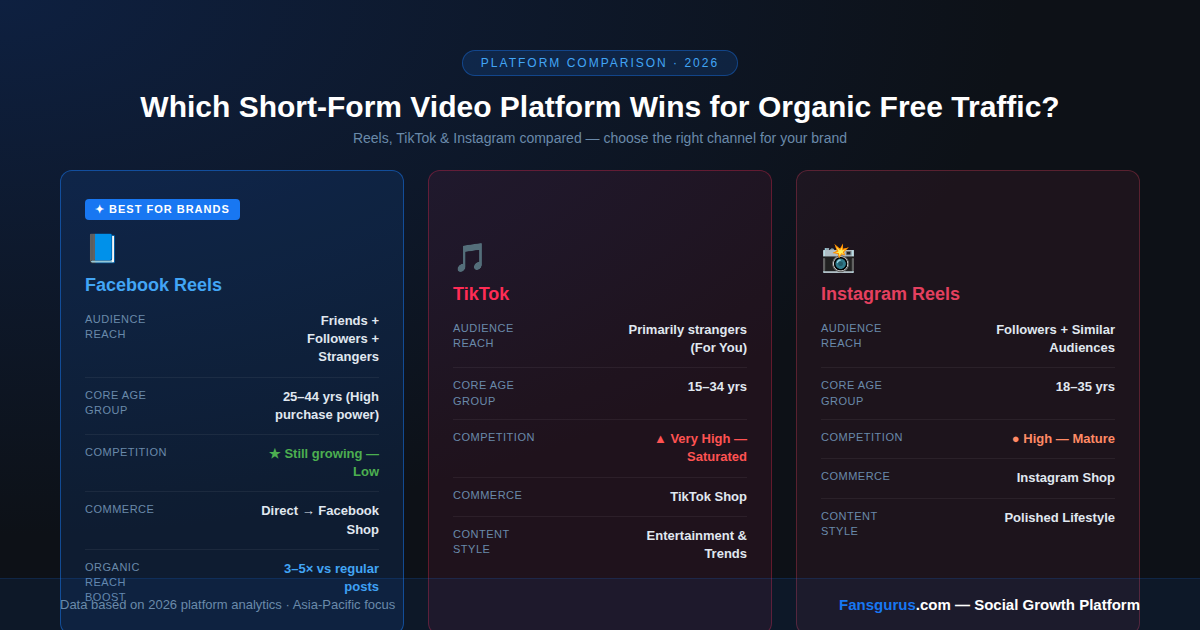
| Dimension | Facebook Reels | TikTok | Instagram Reels |
|---|---|---|---|
| Audience Reach | Friends + Followers + Strangers | Primarily strangers (For You Page) | Primarily followers and similar audiences |
| Content Preference | Emotional resonance, practical value | Entertainment, trending sounds | Polished lifestyle aesthetics |
| Core Demographics | Ages 25–44 dominant | Ages 15–34 dominant | Ages 18–35 dominant |
| Commerce Integration | Direct to Facebook Shop | TikTok Shop | Instagram Shop |
| Competition Level | Lower — still growing | Very high — saturated | High — mature ecosystem |
Key insight: Facebook's older, higher-purchasing-power user base (25–44) responds better to educational and problem-solving content than pure entertainment. For brands selling higher-ticket items with longer decision cycles, Facebook Reels is actually a better fit than TikTok's teen-skewing algorithm.
Low-Cost Reels Production for Free Organic Reach
You don't need a production team. These formats consistently generate strong organic reach for brand pages:
- Product unboxing + demonstration: Filmed on a smartphone — natural lighting, stable shot, no shaky footage
- Customer review visualization: Turn positive reviews into animated text overlays with trending audio
- Problem + Solution format: Hook with the pain point in the first 3 seconds; show the product solving it
- Before vs. After comparison: Strong visual contrast, immediate impact, high completion rates
Batch production strategy: Film one product session and edit it into 5–8 different versions (different hooks, durations, audio tracks). Test them all, double down on the best-performing direction. Post during peak engagement windows — typically 12:00–1:00 PM and 8:00–10:00 PM in your target timezone — to maximize initial interaction velocity and trigger broader algorithmic distribution.
The Facebook Ecosystem Closed-Loop Advantage
Unlike TikTok or YouTube, Facebook's advantage is keeping the entire buyer journey inside one platform:
- Open Facebook Business Manager and connect your catalog to Facebook Shop
- Tag products in your Reels using the Tag Products feature
- Users tap the shopping bag icon on the video and go directly to the product page
Even without a Facebook Shop set up, you can route Reels traffic to: Page → Pinned post → Product link (website/store) or direct Messenger inquiry.
4. UGC Strategy: Turn Your Customers Into Your Free Marketing Team
User Generated Content (UGC) consistently outperforms brand-produced content in conversion rates. Consumers trust other consumers — real unboxing videos, honest reviews, and authentic usage photos carry social proof that no ad creative can manufacture. Building a systematic UGC flywheel is one of the most powerful Facebook free traffic strategies available, because every piece of user content acts as a perpetual endorsement that keeps generating social proof without ongoing cost.
How to Actively Collect UGC From Customers
Most satisfied customers won't share spontaneously — but with the right prompts, they're very willing to. Effective collection touchpoints:
- Package insert cards: A physical card inside the package offering a concrete incentive (discount code, free gift) for tagging your page in a Facebook post. Specific rewards outperform vague "show us your photos" asks every time.
- Post-purchase follow-up messages: Send a Messenger or email message 3–5 days after delivery asking about their experience and inviting them to share. Messenger open rates are far higher than email for most product categories.
- Design share-worthy packaging: Make the unboxing experience itself visually remarkable. If your packaging makes people think "I have to show this," UGC happens organically without any incentive.
- Monthly community challenges: Run "Best [Month] Unboxing" contests in your group or page — people compete for prizes and tag your page in the process.
Systematizing UGC for Maximum Free Traffic Impact
Collected UGC shouldn't just sit in your notifications — build a systematic repurposing pipeline:
- Weekly reposts: Share 1–2 customer posts per week with a thank-you caption. Each reshare notifies the original poster and often generates a second wave of engagement.
- Pin the best UGC: Compile top review videos and unboxing photos into a pinned "What Our Customers Say" post — it's the first thing new visitors see.
- Repurpose for ads: Authentic customer videos routinely outperform brand-produced creatives in click-through rates. Your best UGC is also your best paid ad material.
- Monthly compilation posts: A "This Month's Customer Stories" roundup post with review screenshots builds credibility in a single, shareable format.
Every piece of UGC compounds. When a new visitor browses your page and sees dozens of real customer posts alongside your brand content, the credibility multiplier is enormous — and it cost you nothing but a package insert card.
5. Social Proof Building: Make Your Page Data Work as Free Advertising
How Page Metrics Influence Conversion Rates
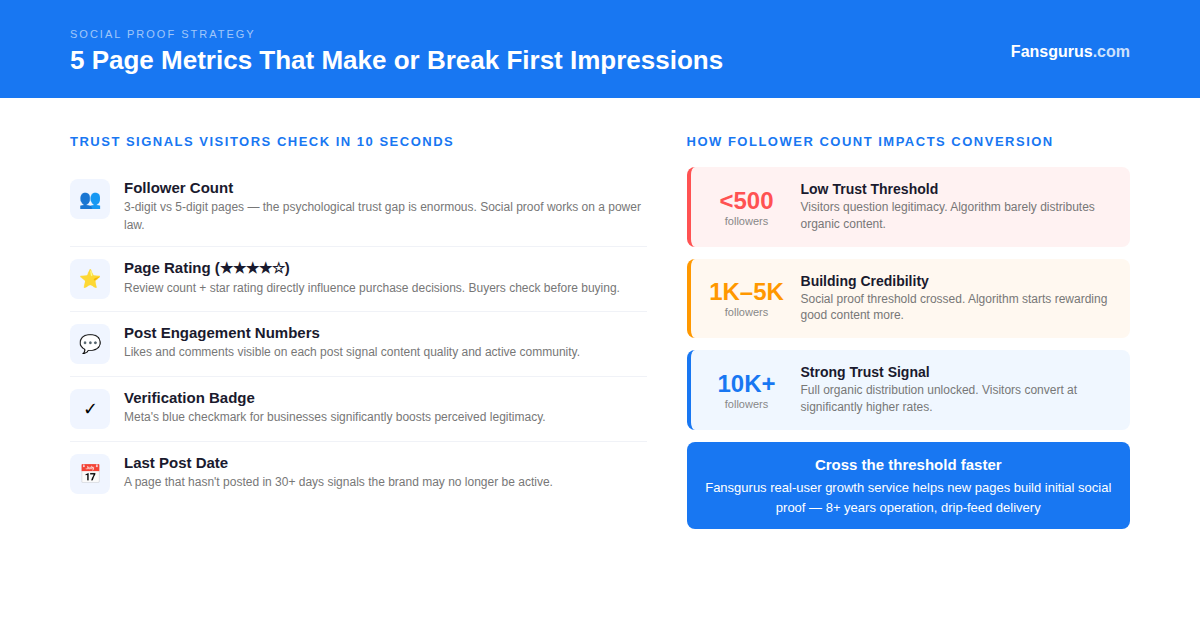
When a cold prospect lands on your Facebook page for the first time, they complete an unconscious credibility check within 10 seconds. The data points driving that snap judgment:
- Follower count: The psychological gap between a 3-digit page and a 5-digit page is enormous. Social proof works on a power law — the more you have, the more you attract.
- Page rating (★★★★☆): Star ratings and review volume directly influence purchase decisions. Buyers across all markets check reviews before buying; a page with zero ratings is a page with zero trust signals.
- Post engagement numbers: Likes and comments visible under each post signal content quality and brand activity to every new visitor.
- Verification status: Meta's blue checkmark for businesses significantly boosts perceived legitimacy.
- Last post date: A page that hasn't posted in 30+ days signals to visitors that the brand may no longer be active — killing conversion before it starts.
"A page with sparse followers and low engagement bleeds potential customers, even if the content quality is good. In markets where buyers follow the crowd, the initial social proof threshold is everything."
Cold-Start Strategy for New Pages: Breaking the Chicken-and-Egg Problem
New pages face the classic growth paradox: no followers means no reach, and no reach means no new followers. Breaking this loop requires simultaneous action on multiple fronts:
Content Pre-loading:
Before actively promoting your page, publish 10–20 high-quality posts. A visitor landing on a complete, content-rich page is far more likely to follow than one landing on an empty or sparse page. Build the foundation before you drive traffic.
Network Effect Activation:
- Personally invite existing customers, business partners, and suppliers to follow the page and leave reviews
- Cross-promote from every other channel you own (website footer, email signature, Instagram bio, YouTube description)
- Link your personal account to the page; your activity in Facebook Groups drives profile visits that convert to page follows
Algorithmic Cold-Start Acceleration:
Facebook's algorithm applies heavy distribution restrictions to new pages — this is universal, not personal. Professional social growth services like Fansgurus can provide real-user follower and engagement boosts that help new pages cross the algorithm's initial recommendation threshold. Fansgurus has operated since 2018 (8+ years), runs a real-person task network of 170,000+ users, and uses drip-feed delivery so growth curves look natural and don't trigger platform risk controls. Once baseline social proof is established, organic content distribution improves noticeably.
Review Cultivation:
- Message every customer personally to invite them to leave a Page rating — make it specific and easy ("It takes 30 seconds and means a lot to us")
- Respond to every review publicly — good ones with genuine thanks, negative ones with prompt resolution. Your responses are visible to all future visitors.
- Page rating volume and quality are ranking signals inside Facebook's internal search algorithm
6. Final Takeaway: The Compounding Logic of Facebook Free Traffic
All five methods above share one core logic: they require upfront time investment, but generate compounding returns over time.
Paid ads are a faucet — turn them off and traffic stops immediately. The trust you build in groups, the social proof accumulated on your page, the UGC matrix of authentic customer voices — these are long-term assets that appreciate with time. Facebook free traffic is never truly "free." Its cost is consistent effort and content quality. But for brands willing to pay that cost, it creates a moat that competitors spending on ads alone can never replicate.
The recommended operating model for most brands:
- Phase 1 (Months 0–6): Build content foundation and social proof through free channels. Use paid ads for minimal testing only.
- Phase 2 (Months 6–18): Once organic channels are producing consistently, use paid ads to amplify top-performing content.
- Mature phase: Free channels provide stable baseline traffic; ad budget concentrates on scaling and new market entry.
For brands that want to accelerate social proof building while building organic momentum simultaneously, Fansgurus's Facebook services can serve as a cold-start accelerator running in parallel with your organic content strategy — giving your page the initial credibility signals it needs to be taken seriously from day one.
7. Frequently Asked Questions
Will promoting products in Facebook Groups get my account banned?
Dropping product links directly in groups — especially as a new member — carries a high ban risk. The safe approach follows the 70/20/10 rule: spend 70% of your activity providing genuine value, 20% on engagement-focused posts, and keep promotional content to just 10% using first-person experience language rather than direct commercial links. Generally, being consistently active in a group for 3–4 weeks before any soft promotion reduces ban risk dramatically. Always read the group's pinned rules before posting — most group admins explicitly state whether promotional content is allowed and in what format.
Is Facebook Marketplace worth it for free traffic compared to selling on Amazon or Shopee?
They serve different strengths and work best in parallel rather than as replacements. Amazon and Shopee offer mature fulfillment infrastructure, trust systems, and high buyer volume — ideal for standardized, high-volume products. Facebook Marketplace's advantages are zero commission fees (Amazon and Shopee both raised fees in 2025–2026), higher buyer purchase intent through active search, and direct Messenger communication for relationship building. Marketplace especially suits higher-ticket differentiated products, second-hand items, handcrafted goods, and anything that benefits from a personal conversation before purchase. Linking your Marketplace listings to your e-commerce store for trust verification maximizes conversion across both channels.
Does Facebook Reels actually get more organic reach than regular posts in 2026?
Yes — significantly. Facebook is still in an active push phase for Reels, prioritizing their distribution in both the News Feed and the dedicated Reels tab to compete with TikTok. Brands consistently report 3–5x higher organic reach for Reels content versus equivalent static posts or carousels. This distribution advantage is a genuine, time-limited window — enjoy it now, because it will normalize as the format matures. The key quality signal for Facebook Reels is watch-through rate: if people watch your video to completion, the algorithm reads it as high-quality content and distributes it more broadly.
How do I get more followers on a new Facebook page fast without spending on ads?
The fastest organic approach combines content pre-loading (publish 10–20 posts before promoting), personal network activation (invite customers and partners), and cross-platform funnel redirects (link every other channel to your Facebook page). For brands that need to accelerate the process, Fansgurus offers real-user Facebook follower and engagement growth services — covering follows, likes, comments, and more across 5,000+ service types — with 8+ years of operation and drip-feed delivery for natural growth curves. Establishing a baseline social proof threshold through this method significantly improves the reach of your organic content going forward.
What is the most effective way to get customers to post UGC on Facebook?
The most consistently effective UGC trigger is the physical package insert — a card inside the shipment offering a specific, concrete reward (a discount code for the next purchase, a free sample) in exchange for tagging your page in a Facebook post. Vague requests generate almost no response; specific, immediate rewards work. The second-highest converting trigger is a Messenger message sent 3–5 days post-delivery, with a personal tone and a direct link to your page. Running monthly photo competitions ("Best Unboxing of [Month]") in your Facebook Group creates a self-reinforcing cycle where winning participants share their posts publicly, amplifying reach beyond your existing community.
What is the best time to post on Facebook for maximum organic reach?
For most markets, peak engagement windows are 12:00–1:00 PM (lunch break) and 8:00–10:00 PM (evening prime time) in your audience's local timezone. These windows give posts the highest chance of accumulating early interactions, which signals the algorithm to distribute the content more broadly. Thursday and Friday evenings consistently outperform Monday and Tuesday. Use Meta Business Suite's scheduling feature to post at these times automatically. That said, your own page's audience insights will give you the most accurate data — check your Page Insights under "Posts" to see when your specific followers are most active and optimize around that.