Written by: Fansgurus Writter ·

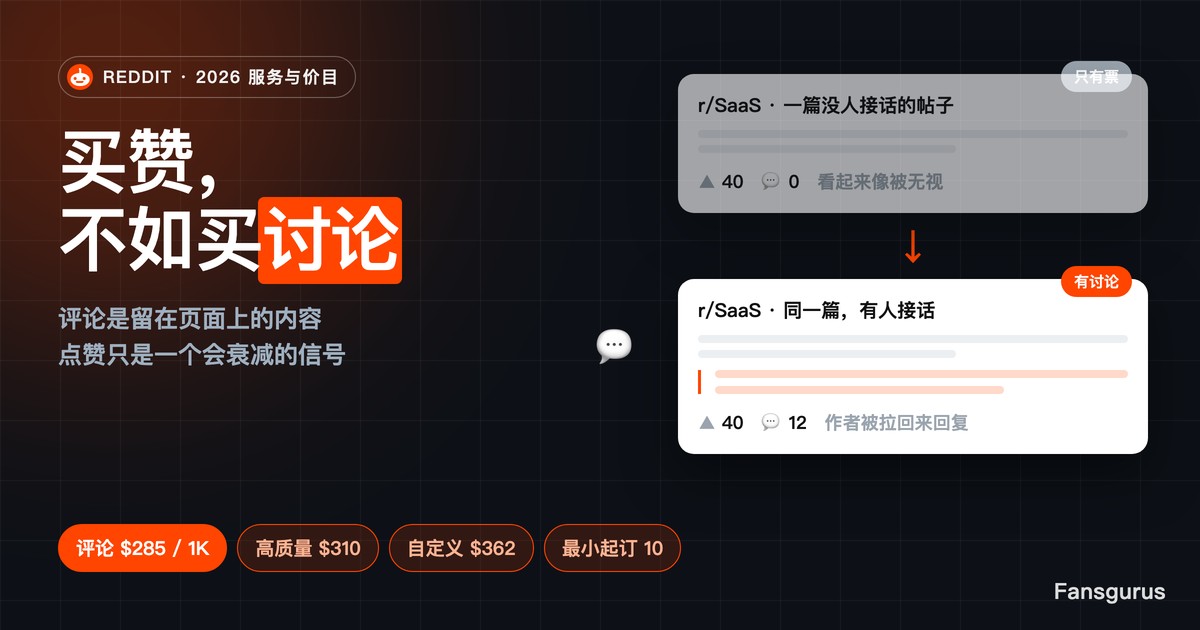
Your post has 40 upvotes and not a single comment. On Reddit, that combination reads as worse than failure — it looks like people glanced and walked away. A silent post tells the algorithm there was nothing worth discussing, and it tells every human who lands on it the same thing.

That is the gap real Reddit comments close. They don't just decorate a post — they generate the discussion depth that Reddit's 2026 algorithm treats as a top-tier quality signal, and that other readers treat as social proof worth joining. This is exactly what Fansgurus' Reddit comment service is built to deliver.

1. What the Reddit Comment Service Is

Fansgurus' Reddit comment service places real, relevant comments from genuine, aged Reddit accounts on the posts you choose. These are not generic "Nice post" one-liners from empty bots — they are contextual replies written to fit the thread, delivered at a natural pace so the conversation builds the way an organic one would. Every account behind them is a real user from the Fansgurus pool of 240,000+ verified members, the same human-interaction backbone that sets the platform apart across every network it serves.

2. Why Comments Move the Ranking More Than Votes Alone

Comments are not a vanity metric on Reddit — they are mechanically tied to how far a post travels:

  • Comment depth is a core ranking signal. Reddit's 2026 algorithm explicitly weighs comment length, reply threads, and meaningful discussion as evidence of quality.
  • Discussion compounds upvotes. Posts with 500+ comments earn roughly 6x the upvotes of posts with under 50 — conversation pulls in more eyes, which pulls in more votes.
  • Substance beats noise. Comments of 76–250 words earn about 4.2x more upvotes than throwaway one-liners, which is why comment quality, not just count, is what the service focuses on.
  • The first hours decide everything. Early discussion velocity feeds the snowball that carries a post toward the top of its subreddit.

3. Service Types

The comment service can be tailored to the goal of the post:

  • Custom comments — you supply the wording or angle, ideal for steering a narrative or seeding specific talking points.
  • Contextual organic comments — written by the accounts to fit the thread naturally, ideal for general discussion lift.
  • Comment + upvote combinations — pairing discussion with early vote velocity for launch posts that need to clear the first-90-minute threshold.

You can review the available comment options on the Reddit custom comments & karma page, or see the full Reddit lineup on the Fansgurus Reddit service page.

4. Pricing

Pricing is transparent and tiered by comment quality, with a minimum order of just 10 comments — so you can seed a single thread without committing to volume:

PackageAccountsPriceGuarantee
Reddit Post Comments (Standard)100% real users · natural comments · instant start$285 / 1,00060-day
Reddit Post Comments (High-Quality)Selected active accounts · natural engagement$310 / 1,00090-day

Minimum order is 10 comments. You can review live packages and order on the Fansgurus Reddit real-human services page.

5. Strengths and What Sets It Apart

Plenty of services will drop comments on a post. What distinguishes this one:

  • Real, aged accounts — comments come from genuine users with posting history, so they read as authentic and survive moderation scrutiny far better than fresh-account spam.
  • Relevance, not filler — replies are written to fit the thread, because the algorithm rewards depth and real readers ignore obvious padding.
  • Natural pacing — discussion is delivered at a human rhythm rather than a suspicious burst, protecting the post and the account.
  • Verifiable — you can open the commenting profiles and see real avatars, histories, and activity.

6. Data Stability

Stability is often the deciding factor for buyers, and it is where account quality shows. Because the comments come from real, long-term active accounts rather than disposable bots, they are far less likely to be removed in moderation sweeps or to vanish in a platform cleanup. Fansgurus backs delivery with refill support, so if anything drops, it is restored — the discussion you paid to seed stays on the post and keeps working for its ranking.

7. The Problem It Solves

Come back to that silent post with 40 upvotes and zero replies. Without discussion, it stalls: the algorithm sees no depth, readers see no reason to engage, and a piece of content that could have climbed instead flatlines. Seeding a handful of real, substantive comments early gives the thread the first push — it signals quality to the algorithm and gives genuine users a conversation to join, which is how a post goes from "ignored" to "active." That is the specific job the Reddit comment service does. To start, reach the Telegram support team with the post you want to lift.

8. Frequently Asked Questions

Are bought Reddit comments from real accounts?

With Fansgurus, yes — comments come from real, aged accounts in a pool of 240,000+ verified users, not empty bots. You can open the commenting profiles to verify avatars, histories, and activity, which is exactly what makes them survive moderation and read as authentic.

Will buying Reddit comments get my post or account banned?

The risk comes from spammy, identical comments from fresh accounts delivered in a burst. Real, relevant comments from aged accounts delivered at a natural pace behave like organic discussion. Pairing them with genuine content is the safest approach.

Do Reddit comments really help a post rank?

Yes. Reddit's 2026 algorithm treats comment depth and discussion as a core quality signal, and posts with 500+ comments earn roughly 6x the upvotes of posts with under 50. Comments of 76–250 words earn about 4.2x more upvotes than one-liners, so quality matters as much as quantity.

Can I choose what the Reddit comments say?

Yes — custom comments let you supply the wording or angle to steer a narrative, while contextual comments are written to fit the thread naturally. Fansgurus offers both depending on whether you want control or organic feel.

How many Reddit comments should I buy for a post?

Enough to start a real conversation, not flood it — a handful of substantive early comments usually does more than dozens of shallow ones, because depth and natural pacing are what the algorithm and other readers respond to. The Fansgurus team can advise based on the subreddit and post.

How a B2B Startup Used LinkedIn to Generate 200 Leads a Month
Written by: Fansgurus Writter ·

In January, a 12-person B2B SaaS startup — call it NorthLoop — had a company page with 800 followers, a posting calendar nobody followed, and exactly four inbound leads from LinkedIn that month. Their CEO assumed LinkedIn "didn't work for a company their size." Five months later, the same channel was producing around 200 qualified leads a month, with no increase in ad spend.

Nothing about their product changed. What changed was who did the posting, what they posted, and how they treated the first hour after hitting publish. Here is the month-by-month breakdown — and the framework you can lift directly.

1. The Starting Point: Invisible on the Company Page

NorthLoop had been doing what most startups do: pushing all content through the company page. The math was working against them. A company page post reaches just 1–5% of followers, so their 800-follower page was talking to a few dozen people on a good day. The page wasn't broken — it was structurally capped.

The decision that changed everything was simple: stop treating the page as the channel, and make the founder the channel.

2. Month 1 — The Founder Becomes the Channel

The CEO started posting from her personal profile three to five times a week, on one narrow topic: the operational headaches her software solved for finance teams. No product pitches — just specific, hard-won observations from years in the field.

The reach difference was immediate. Identical content that died on the company page now reached 10–25% of her first-degree connections, and the algorithm began learning her "topic DNA," pushing her posts to finance operators who didn't yet follow her. By the end of month one, inbound had gone from 4 to roughly 30.

3. Month 2 — Betting on Dwell Time with Documents

Next, NorthLoop leaned into the format that wins on attention: document carousels. Each week the CEO turned one real customer problem into an 8–10 slide PDF — a teardown, a checklist, a framework.

Document posts lead all LinkedIn formats at around 6.60% average engagement precisely because people swipe through slide by slide, racking up dwell time — and dwell time is the metric the 2026 algorithm trusts most. The carousels consistently outran her text posts, and reach compounded as the algorithm rewarded the time people spent.

The exact 8-slide structure she reused every week:

  1. Slide 1 — the problem, named specifically: "Why finance teams still close the books in 10+ days."
  2. Slide 2 — the cost of it: the hours, the errors, the late reporting that problem causes.
  3. Slides 3–6 — one fix per slide: four concrete, do-it-tomorrow changes, each with a before/after.
  4. Slide 7 — the result: a real number (days, hours, or % saved).
  5. Slide 8 — the takeaway + one question to pull comments.

No design skills required — plain slides with one idea each outperform busy graphics, because the win is dwell time, not polish. She wrote the caption (the text above the document) as a 3-line hook, kept the link out of the body, and dropped any further reading into the first comment.

4. Month 3 — Engineering the First 60 Minutes

By now the team understood that a post lives or dies in its first hour — only about 5% of slow-starting posts ever recover. So they got deliberate about early engagement.

The CEO posted when her audience was active, then stayed in the comments for the first hour answering every reply in depth — which both raised dwell time and pulled in more commenters. Because posts that draw 3+ commenters early get around 5.2x reach amplification, and comments carry roughly 15x the weight of a like, this single habit moved more posts into broad distribution than any other change.

5. Months 4–5 — Employee Advocacy Multiplies Everything

The final unlock was turning one voice into many. NorthLoop brought eight employees into a light advocacy routine: each reshared and added their own perspective to the best company content from their personal profiles.

Because employee networks are collectively about 10x larger than the company follower list, and employee advocacy can generate roughly 561% more reach and 7x more lead conversion than the page alone, the same ideas now traveled through eight credible humans instead of one logo. Reach stopped being linear and started compounding.

6. The Result: 200 Leads a Month — and Where They Came From

MonthPrimary moveInbound leads / month
StartCompany-page only~4
Month 1Founder posts personally, one topic~30
Month 2Document carousels for dwell time~70
Month 3First-60-minute engagement~120
Months 4–5Employee advocacy~200

The mechanism behind the number is well documented: 78% of B2B buyers say they're more likely to engage with a company after reading the founder's personal content, and founders commonly report that 20–35% of inbound leads name LinkedIn content as the first touchpoint. NorthLoop didn't beat those benchmarks — they simply stopped leaving them on the table.

7. The Framework You Can Copy

  • Move the channel from page to founder. The company page is for credibility and ads; the founder's profile is for reach.
  • Commit to one topic, 3–5 posts a week. Let the algorithm learn your topic DNA.
  • Default to document carousels and native video to manufacture dwell time.
  • Own the first 60 minutes — post when your audience is live and reply to every early comment.
  • Add employee advocacy once the founder's motion works, to multiply reach 10–20x.

None of it required a bigger budget — only a different understanding of how attention moves on LinkedIn. If your own funnel converts poorly once people do see you, our breakdown of why LinkedIn connection requests don't convert pairs naturally with this playbook, and how to grow a LinkedIn following covers the audience-building side.

8. Frequently Asked Questions

Is 200 LinkedIn leads a month realistic for a small B2B startup?

It's realistic over a few months, not overnight. The growth here came from compounding: founder-led posting, document formats, first-hour engagement, then employee advocacy. Each layer multiplied the last, which is how a small team reaches numbers that look out of reach at the start.

Why post from the founder's profile instead of the company page?

A founder post reaches 10–25% of connections versus 1–5% of followers for a page, and 78% of B2B buyers are more likely to engage after reading founder content. The page stays useful for credibility and ads, but reach lives on the personal profile.

What type of post generated the most leads?

Document carousels. They lead all formats at ~6.60% engagement because they maximize dwell time — the signal the 2026 algorithm rewards most — turning one customer problem into a swipeable teardown.

How long until LinkedIn lead generation pays off?

In this case, meaningful lift came within the first month and scaled over five. The pace depends on consistency and how deliberately you work the first 60 minutes after each post, since early engagement velocity decides total reach.

Do employees really need to be involved?

They're the multiplier. Employee networks are collectively about 10x larger than a company's followers, and advocacy can drive 561% more reach and 7x more lead conversion than the page alone — which is what took this team from ~120 to ~200 leads a month.

LinkedIn for Founders: Why Personal Branding Beats Company Pages in 2026
Written by: Fansgurus Writter ·

Here is a number that should reframe how every founder spends their LinkedIn time in 2026: a personal profile generates roughly 561% more reach than a company page sharing the exact same content. Same words, same link, same day — one carries five times further than the other.

For years, the default playbook was "build the company page." In 2026 the data says the opposite: the founder's face, not the company logo, is the distribution engine. Here is why the gap exists, what it means, and how the company page still earns its place.

1. The Reach Gap Is Not Small — It's Structural

The performance difference between a personal profile and a company page has stopped being a rounding error:

  • Personal profiles drive about 8x more engagement than company pages.
  • The same content posted personally reaches roughly 561% more people and earns 2.75x more impressions and 5x more engagement.
  • A founder's post typically reaches 10–25% of first-degree connections; a company page post reaches just 1–5% of followers.
  • Founders who post 3–5 times a week see about 6x higher organic reach than their own company page.

This is not a content-quality problem that better brand copy can fix. It is structural — the algorithm treats the two account types differently from the start.

2. Why the Algorithm Structurally Favors Humans

The 2026 LinkedIn feed rewards conversation, and people simply talk to people more than they talk to logos. Posts that trigger 3+ commenters in the first 60 minutes get around 5.2x reach amplification — and peers comment on a founder's post far more readily than on a brand page's.

Because comments now carry far more algorithmic weight than likes, and because early comment velocity decides distribution, the personal profile starts every race with an advantage the company page can't match. The logo doesn't get replies; the person does.

3. B2B Buyers Are Already Watching the Founder

This isn't just an algorithm story — it's a buyer-behavior story. 78% of B2B buyers say they are more likely to engage with a company after reading the founder's personal content on LinkedIn. And founders with an active presence report that 20–35% of inbound leads cite their LinkedIn content as the first touchpoint.

In other words, the founder's feed has quietly become a top-of-funnel asset. Buyers trust a human point of view, shared consistently, in a way they never trusted a company's broadcast channel.

4. So What Is the Company Page Still For?

Personal-first does not mean abandon the page. In 2026 the company page plays a clear supporting role:

JobPersonal ProfileCompany Page
Organic reach & engagement✅ Primary engineLimited
Trust & point of view✅ Founder voiceSupporting
Credibility / "does this company exist"Indirect✅ Essential
Paid advertisingNo✅ Required
Careers, updates, official recordNo✅ Home base

The page is your credibility anchor and ad platform; the founder profile is your reach and trust engine. Build the page well, but spend your attention on the profile.

5. Scaling the Advantage: Employee Advocacy

If one personal profile beats the company page, many of them compound it. Employee networks are, in aggregate, about 10x larger than a company's follower list, and employee advocacy programs generate roughly 561% greater reach, 2.75x more impressions, and 7x more lead conversion than the company page posting alone.

The 2026 move for any B2B team is to turn the founder's personal-branding advantage into a system: empower 10–50 employees to share through their own profiles, and the same content that reached 1–5% from the page now reaches 10–20x further through humans.

6. A Founder's Starting Playbook

If you're a founder starting from near-zero, four moves capture most of the upside:

  • Pick one lane. Post consistently on the narrow topic you have real authority in, so the algorithm learns your "topic DNA."
  • Post 3–5 times a week. That cadence is where the 6x reach advantage over the company page shows up.
  • Write for replies. End with a genuine question; early comments are what trigger the 5.2x amplification.
  • Build credibility first. A complete profile, a real network, and steady engagement matter before reach compounds — and a credible, active account is what makes everything else land.

A concrete weekly structure a founder can copy. "Post 3–5 times a week" is useless without knowing what to post. This rotation keeps you on one topic without running dry:

Post typeWhat it isWhy it works
The teardownOne real customer problem, broken into a 5-step fix (ideally a document carousel)Maximizes dwell time; demonstrates expertise directly
The contrarian takeOne "best practice" in your field that you think is wrong, and whyTension drives early comments — the 5.2x amplification trigger
The behind-the-scenesA specific decision or mistake from building the company, with the lessonHumanizes the founder; this is what 78% of buyers respond to
The proof pointA concrete result or metric (yours or a customer's), with the method behind itBuilds credibility without pitching

For example, instead of "We help finance teams save time," a teardown post opens: "A 40-person finance team was closing their books in 11 days. Here's the exact 5-step change that got them to 4 — step 3 is the one everyone skips." Specific, useful, and it earns the dwell time and comments that the algorithm rewards. Run this rotation for eight weeks before judging results — reach on personal profiles compounds, it doesn't spike.

For the structure of a sustainable posting plan, see our 2026 LinkedIn content strategy; for the page side, the company page growth guide covers the supporting role well. A consistent founder voice, backed by a credible account, is the durable advantage — some teams use real engagement support from platforms like Fansgurus to firm up early credibility, but the voice is what compounds.

7. Frequently Asked Questions

Is a personal profile really better than a company page on LinkedIn in 2026?

For organic reach and engagement, yes — decisively. Personal profiles see about 8x the engagement and 561% more reach than company pages on identical content. The page still matters for credibility and ads, but the founder profile is the distribution engine.

Why does LinkedIn favor personal profiles over company pages?

The 2026 algorithm rewards conversation, and people comment on people far more than on logos. Posts with 3+ early commenters get ~5.2x amplification, and personal profiles structurally earn those comments more easily than brand pages.

Does founder content on LinkedIn actually generate leads?

Yes. 78% of B2B buyers are more likely to engage after reading a founder's content, and founders report that 20–35% of inbound leads name their LinkedIn posts as the first touchpoint.

Should I delete my company page and only post personally?

No. Keep the page as your credibility anchor and advertising base, but invest your posting attention in personal profiles — yours and your team's via employee advocacy, which can multiply reach 10–20x.

How does a founder with few followers start building a personal brand?

Pick one topic, post 3–5 times a week, and write posts that invite replies. A complete, credible, active account is the foundation; some founders use real engagement services such as Fansgurus to support early credibility, but consistent expertise is what makes reach compound.

How the LinkedIn Algorithm Decides What Goes Viral in 2026
Written by: Fansgurus Writter ·

Most people still think a LinkedIn post takes off because of luck, follower count, or posting at the perfect hour. In 2026, none of those is the real lever. The algorithm has quietly stopped rewarding reach for its own sake — and started rewarding something much harder to fake: proof that people actually paid attention.

Understand that shift and "going viral" stops being a mystery. It becomes a set of signals you can deliberately engineer. Here is exactly how the 2026 LinkedIn feed decides what to amplify.

1. From "Viral Reach" to "Depth and Authority"

The headline change in 2026 is philosophical: LinkedIn shifted its ranking system away from raw virality toward what it internally frames as depth and authority. The feed no longer asks "how many people can this reach?" first. It asks "is this worth someone's attention, and does this author have standing on the topic?" Everything below flows from that single reframing.

2. Dwell Time: The Only Hard Currency the Algorithm Trusts

The single most important metric in 2026 is dwell time — the actual seconds a person spends actively engaged with your post, not whether they tapped "like" on the way past.

The gap is brutal. Posts where readers bounce in 0–3 seconds earn around 1.2% engagement. Posts that hold attention for 61+ seconds earn 15.6% — a 13x difference driven by nothing but how long people stayed. Attention, not applause, is what the AI now treats as the ultimate signal of quality.

The practical consequence: your first line has one job — stop the scroll — and your structure has another — keep people reading to the end.

3. The First 60 Minutes Decide Everything

LinkedIn doesn't show a new post to your whole network. It tests it on roughly 2–5% of your connections first, then uses how that small group responds to decide whether to widen distribution.

This test window is unforgiving. Only about 5% of posts that underperform in the first hour ever recover to reach a broader audience. Early engagement velocity — how many meaningful interactions land in the first 60 minutes — remains the single strongest predictor of total reach. A post lives or dies in its first hour.

4. Comments Carry 15x the Weight of Likes

Not all engagement is equal. According to 2026 data analysis, a comment now carries roughly 15x the algorithmic weight of a like. A like is a reflex; a comment is dwell time plus a public signal that the post was worth responding to.

This is why posts that provoke a genuine reply — a question, a contrarian take, a framework people want to add to — outrun posts that simply collect silent likes. If you want reach, design for conversation, not approval.

5. "Topic DNA": Distribution by Expertise, Not Network Size

One of the most under-appreciated 2026 mechanics: the algorithm builds a "topic DNA" for every account and distributes content based on demonstrated expertise rather than how many followers you have. An educational post with a clear framework and real data can be pushed to people interested in that topic even if they don't follow you.

This is genuinely good news for smaller accounts. Consistency on a narrow topic compounds — the more you post substance in one lane, the more the algorithm trusts you as a source there, and the further it carries you beyond your immediate network.

LinkedIn wants to keep people on LinkedIn. Posts with a link to an external website see roughly 60% less reach than an identical post without one. The well-known workaround is to keep the post link-free and place the link in the first comment instead — but the deeper lesson is that the feed rewards content that is complete in itself, not content that exists to send people elsewhere.

7. What Formats Win in 2026

Format choice is a reach decision. The current ranking:

FormatAvg. EngagementWhy it wins
Document / PDF carousel6.60%High dwell time — people swipe through slide by slide
Native video5.60%Holds attention; auto-plays in feed
Text + single imageMidFast to read, easy to comment on
Text-onlyVariableWins on a strong hook; loses without one

Document carousels lead precisely because they maximize the metric that matters most — they manufacture dwell time by design.

8. Turning the Algorithm Into a Playbook

Translate the mechanics into deliberate moves:

  • Engineer dwell time: a scroll-stopping first line, short paragraphs, and a structure that pays off only at the end.
  • Own the first 60 minutes: post when your audience is active and be present to reply, because early velocity decides total reach.
  • Design for comments: end with a real question or a take worth arguing — comments are worth 15x a like.
  • Pick one lane: post consistently on a narrow topic so the algorithm reads your topic DNA and distributes you to non-followers.
  • Keep links out of the post body to avoid the ~60% reach penalty.
  • Default to documents and native video for the formats that structurally win on attention.

What a high-dwell post actually looks like. Principles are easy to nod at and hard to apply, so here is the exact skeleton that consistently clears the 60-second dwell-time mark:

  • Line 1 — the hook: a specific, slightly contrarian claim with a real number. Not "Engagement matters," but "I read 40 SaaS founders' posts last week — the 9 that took off all broke the same 'best practice.'" A concrete number plus a little tension is what stops the scroll.
  • Lines 2–4 — one sentence per line: each on its own line with a blank line between, so the reader's eye keeps moving down the post instead of bouncing out of a dense block.
  • The middle — a numbered teardown (3–5 points): people read lists to the end far more often than paragraphs, and every extra point read is more dwell time banked.
  • The close — one real question for practitioners: "Which of these are you already doing?" turns passive readers into the early commenters who decide your reach.

Notice what is not there: no link in the body (that costs ~60% reach), no "Agree?" filler, no wall of hashtags. Every line exists to hold attention one beat longer. Run your next post against this checklist before you publish — if a line doesn't earn its place by adding tension, information, or momentum, cut it.

None of this requires gaming the system. It requires building real authority on a topic and giving people a reason to stay — which is exactly what the 2026 algorithm was redesigned to reward. For a deeper breakdown of why reach collapses when these signals are missing, see our guide on why LinkedIn reach drops in 2026, and how to structure a posting plan in the 2026 LinkedIn content strategy.

9. Frequently Asked Questions

What actually makes a LinkedIn post go viral in 2026?

Dwell time and early comment velocity. A post that holds attention for 60+ seconds and earns real comments in the first hour gets amplified; one that collects silent likes does not. Reach is a downstream result of attention, not the goal itself.

Why does the first hour matter so much on LinkedIn?

LinkedIn tests every new post on 2–5% of your network, and only about 5% of posts that underperform in that first hour ever recover. Early engagement velocity is the strongest single predictor of how far a post travels.

Do I need a lot of followers to get reach on LinkedIn?

No. The 2026 algorithm distributes by "topic DNA" — demonstrated expertise on a subject — not raw follower count, so consistent, substantive posting on one topic can reach people who don't follow you. A credible, active account helps; some creators use real engagement services such as Fansgurus to support early account credibility, but the durable lever is consistent expertise.

What content format gets the most reach on LinkedIn in 2026?

Document (PDF carousel) posts lead at about 6.60% average engagement, followed by native video at 5.60%. Both win because they maximize dwell time — the metric the algorithm now weighs most heavily.

Why Is Your LinkedIn Reach So Low? Understanding the 2026 Feed Algorithm
Written by: Fansgurus Writter ·
Why Is Your LinkedIn Reach So Low? Understanding the 2026 Feed Algorithm | Fansgurus

You post consistently. You have followers. But over the last few months, your posts just disappear—views have crashed from thousands to hundreds, comments are sparse. You're not alone. According to Richard van der Blom's 2026 LinkedIn Algorithm Report, average reach has permanently reset to a lower baseline. But here's what most "LinkedIn is broken" articles miss: some accounts aren't just recovering their reach, they're exceeding last year's numbers. The difference isn't effort. It's understanding the rules that actually work in 2026.

LinkedIn Connection Requests Not Converting? How to Fix Your Sales Funnel
Written by: Fansgurus Writter ·
LinkedIn Connection Requests Not Converting? How to Fix Your Sales Funnel

You sent out 300 LinkedIn connection requests last month. Only 36 were accepted. Of those, 12 people opened your first message. None converted into opportunities.

You're not bad at sales. Your LinkedIn connection request strategy is broken at every single stage.

Research shows that prospects who receive a sales pitch within the first message are 5x more likely to disconnect. Yet this is exactly what most B2B salespeople do.

The average B2B sales professional achieves a LinkedIn connection request acceptance rate of just 15-25%. Of those who accept, only 5-10% ever move into a real conversation. That means 90% of your effort is wasted.

The problem isn't adding too few people. The problem is that your funnel is leaking at 5 critical points. Here's exactly what's broken—and the complete 8-week roadmap to fix it.

How to Grow a LinkedIn Company Page From Zero: 8 Tactics for 2026
Written by: Fansgurus Writter ·
How to Grow a LinkedIn Company Page From Zero: 8 Tactics for 2026

Most companies trying to grow their LinkedIn company page start with the same approach: post more, post frequently, post in every format imaginable. But according to 2026 LinkedIn algorithm data, this strategy is backward from the start. The real driver of company page growth isn't content frequency—it's people. Specifically, your employees.

LinkedIn 2026 Content Strategy: How to Get More Impressions on Every Post
Written by: Fansgurus Writter ·
LinkedIn 2026 Content Strategy: How to Get More Impressions on Every Post

Why do you post content on LinkedIn every week, but your follower count remains stagnant? Why can some creators get thousands of impressions per post while yours struggle to reach even a hundred? The problem is likely not your content quality—it's your content strategy.

Buy LinkedIn Post Likes & Comments: Boost B2B Content Credibility
Written by: Fansgurus Writter ·
Buy LinkedIn Post Likes & Comments: Boost B2B Content Credibility

On LinkedIn, what actually makes a prospect trust you is often not what your post says — it is the row of likes underneath it and the handful of comments where people are genuinely discussing your point. Your content decides what you said; the engagement decides whether anyone believes it. And there is a twist unique to LinkedIn: a substantive comment carries far more algorithmic weight than a like.

Binance Square Red Packet Campaigns: How to Run One That Actually Grows Followers
Written by: Fansgurus Writter ·
Binance Square Red Packet Campaigns: How to Run One That Actually Grows Followers

A Layer2 research creator on Binance Square sent out a 200 USDT red packet post last month. Within 48 hours it had been claimed 380 times. When the campaign ended, he checked his dashboard: 14 new followers. The money was spent, the buzz was real, but the follower count barely moved.

Telegram
WhatsApp