How to Get More Trustpilot Reviews From Real Customers in 2026
Fansgurus Editorial Team
·
created at:2026-07-28 10:14:50
·
updated at:2026-07-29 02:00:47
article keywords tips:
#get more trustpilot reviews
#how to get trustpilot reviews
#trustpilot review invitations
#trustpilot automatic feedback service
#increase trustpilot review response rate
#trustpilot invitation template
Short answer: the number of Trustpilot reviews you get from real customers is the product of exactly three levers — how many invitations you are allowed to send (Free 50, Starter 100, Plus 300, Premium 1,000 per month), how many of them convert, and how many customers are still inside the 12-month eligibility window. Everything that actually works is one of those three: raise the quota, raise the response rate, or stop letting eligible customers age out. Tactics that feel productive but touch none of them — rewriting your profile, chasing individual customers, asking happy people only — either do nothing or get your reviews removed.
This guide is the execution half of the decision we laid out in verified reviews vs organic invites. Here we assume you have chosen to build the invitation programme, and we go through the quota maths, the six collection methods, the send-timing that moves response rate most, copy-ready invitation templates, and the diagnostic list for when your rate is stuck at 3%.
1. How many invitations can you actually send, and how many reviews does that become?
Start with the ceiling, because it tells you whether your target is even reachable. Trustpilot's published invitation quotas as of July 2026:
Plan
Invitations / month
Invitations / year
Reviews / year at 10% response
Free
50
600
60
Starter ($99/mo, up to $5M revenue)
100
1,200
120
Plus ($319/mo)
300
3,600
360
Premium ($799/mo)
1,000
12,000
1,200
Two readings matter. The Free plan produces roughly 60 reviews a year at a 10% response rate, which sits below the 100 reviews in 12 months that Google Seller Ratings requires per country. And the quota is not the only ceiling — you also cannot send more invitations than you have eligible customers, which is where the next rule bites.
The 12-month window nobody puts on the checklist
Trustpilot lets a business flag a review if the reviewer wrote it more than 12 months after their experience. That single line has a planning consequence most merchants miss: your invitable list is not "every customer we have ever had". It is customers whose experience happened inside the last 12 months. A backlog of 4,000 orders from three years ago is not a review asset — it is expired inventory.
Practical version: build your invitation list as a rolling window. Every month, the customers who transacted 13 months ago drop out. If you are sitting on a large recent backlog, do not dump it in one batch either — that spike is the exact shape Trustpilot's detection layer is built to notice. Spread it across the quota month by month, oldest-first, so nothing ages out while you wait.
2. Which invitation method should you use?
Trustpilot offers several ways to ask, and they differ mainly in how much engineering you need and whether the invitation fires automatically. Any business can use them for free, within the plan quota.
Method
What it takes to set up
Best for
Automatic Feedback Service (AFS)
Send order data automatically after each transaction; invitations fire on their own
Any store with a steady order flow — this should be your default
Platform integrations
Connect your e-commerce platform or marketing tool, no code
Merchants already on a mainstream cart or email tool
Company API Link
Generate a link and drop it into your own transactional emails
Teams that want the invitation inside their own email design
List upload
Upload a customer file manually
Clearing a recent backlog, or businesses with no order system
Business generated links
Copy a link, paste it anywhere you already talk to customers
Service businesses that close over chat, WhatsApp or phone
Reminder emails
A toggle, not a project
Everyone — Trustpilot puts these at ~35% more reviews on average
If you only do one thing this week, turn on reminders. It is the single highest ratio of result to effort available, because it raises response rate without consuming extra quota from new customers, and the invitation templates themselves come ready in 16 languages so a multi-market store does not need to write copy from scratch.
3. When should the invitation go out?
Send timing is where most of the response-rate difference lives, and it is also a compliance question, not just an optimisation one. Trustpilot's guidelines say to give consumers a chance to experience the product or service before asking, and specifically call out that inviting only at an early stage — right after an initial consultation or a promotional offer — produces unbalanced, overly positive reviews that do not reflect the complete experience.
So "invite the second payment clears" is both the worst-converting choice and the one closest to the line. Working trigger points by business type:
Business type
Trigger the invitation on
Why here
Physical goods
2–3 days after delivery confirmation
The product has been opened and used; shipping anxiety is over
Services / installation
The evening of completion day
The experience is fresh and the outcome is already visible
SaaS / subscriptions
After the first real value moment, not after signup
A user who has not done the core action has nothing to review
Support tickets
24 hours after the ticket is closed — every ticket, not the happy ones
Resolution is recent; filtering by outcome is a guidelines breach
Long-lead / high-ticket
Two stages: after handover, and again at 60–90 days
Guidelines explicitly allow inviting at several stages of the journey
One more timing detail: pace the daily send instead of firing a whole month's quota on the first of the month. A steady daily trickle produces a steady review inflow, and a steady inflow is what keeps a TrustScore stable — the score weights newer reviews more heavily, so a business that collects in bursts watches its score sag between bursts.
4. What should the invitation actually say?
The rules are short: invite everyone the same way, use fair and neutral language, never suggest that only positive reviews are wanted, and never attach any benefit to writing one. Within those rules there is still a large gap between copy that converts at 4% and copy that converts at 15%.
Three rewrites that fix most invitations
Common wording
Problem
Rewrite
"Leave us a 5-star review and get 10% off"
Two breaches at once: an incentive, and steering the rating
"How did your order go? Your honest review helps other shoppers decide."
"If you're happy, review us. If not, reply to this email."
Textbook gating — Trustpilot lists this exact pattern as misuse
"Tell us how it went — good or bad. If something went wrong, our team is on support@… too."
"Please support our small business with a review 🙏"
Emotional pressure toward a positive rating; also converts poorly
"Two minutes of your time helps the next buyer know what to expect."
A template you can paste in
Subject: How was your [product name]?
Hi [first name],
Your order arrived on [date], so you have had a few days with it now.
Would you share how it went? It takes about two minutes, and your review — whatever the rating — is what the next person reads before they decide.
[Write your review]
If anything did not go to plan, we would rather fix it: reply here or reach us at [support email].
[Name], [Company]
Why it works: it names the specific purchase and date (relevance), it states the time cost (removes friction), it explicitly welcomes any rating (compliant and, counter-intuitively, higher-converting because it does not read as a favour request), and it offers the support path in addition to the review rather than instead of it.
5. Why can't you survey customers first and invite only the happy ones?
Because that is the single most common way a well-meaning merchant ends up with removed reviews and a compliance record. Trustpilot's Action We Take policy lists it as misuse in two separate forms: "picking and choosing which consumers you invite, including only inviting consumers likely to have had a positive experience", and "asking customers to write a review if they had a positive experience, but to contact the business directly if they're unhappy". The guidelines also state plainly that cherry-picking is illegal, not merely against the rules.
It is also easy to detect without reading a single review, because the shape of the data gives it away: a profile whose invited reviews are 96% five-star while the same company's support tickets, refunds and product returns say otherwise is a statistical outlier, and the detection layer analyses behavioural data points, not just review text.
If you have been gating and want to unwind it safely, the fix is boring: switch the trigger to an unconditional event (delivery confirmed, ticket closed), stop segmenting the list by sentiment, and accept that your average will dip for a month or two. A 4.4 built on everyone is worth more than a 4.9 built on a filtered list — and it survives. What happens when it does not is covered in the compliance removals guide.
6. Your response rate is stuck at 3%. Where is the leak?
Work down this list in order — it is sorted by how often each item turns out to be the cause.
The trigger fires too early. Invitations sent at payment rather than at delivery ask people to review something they have not received. This alone commonly halves the rate.
Reminders are off. Roughly a third of the reviews you are missing are in the second email you never sent.
The list is dirty. Typo'd addresses, role inboxes, and customers who already reviewed all consume quota and return nothing. Deduplicate before every send.
The subject line reads like marketing. "We value your feedback" is invisible in an inbox. Name the actual product or order.
Sender authentication is missing. If your domain is not properly authenticated, invitations land in spam and your rate is not a copy problem at all.
Wrong language. Templates come in 16 languages; a French customer receiving English copy converts at a fraction of the rate.
Mobile experience. Most invitations open on a phone. If the link takes more than one tap to reach the review form, you lose people at the door.
Measure after each change, one change at a time, using the invitation conversion view in your Trustpilot account. The order above is deliberate: the first two are free and usually worth more than the other five combined.
7. Where does the real-customer route top out, and what do you do then?
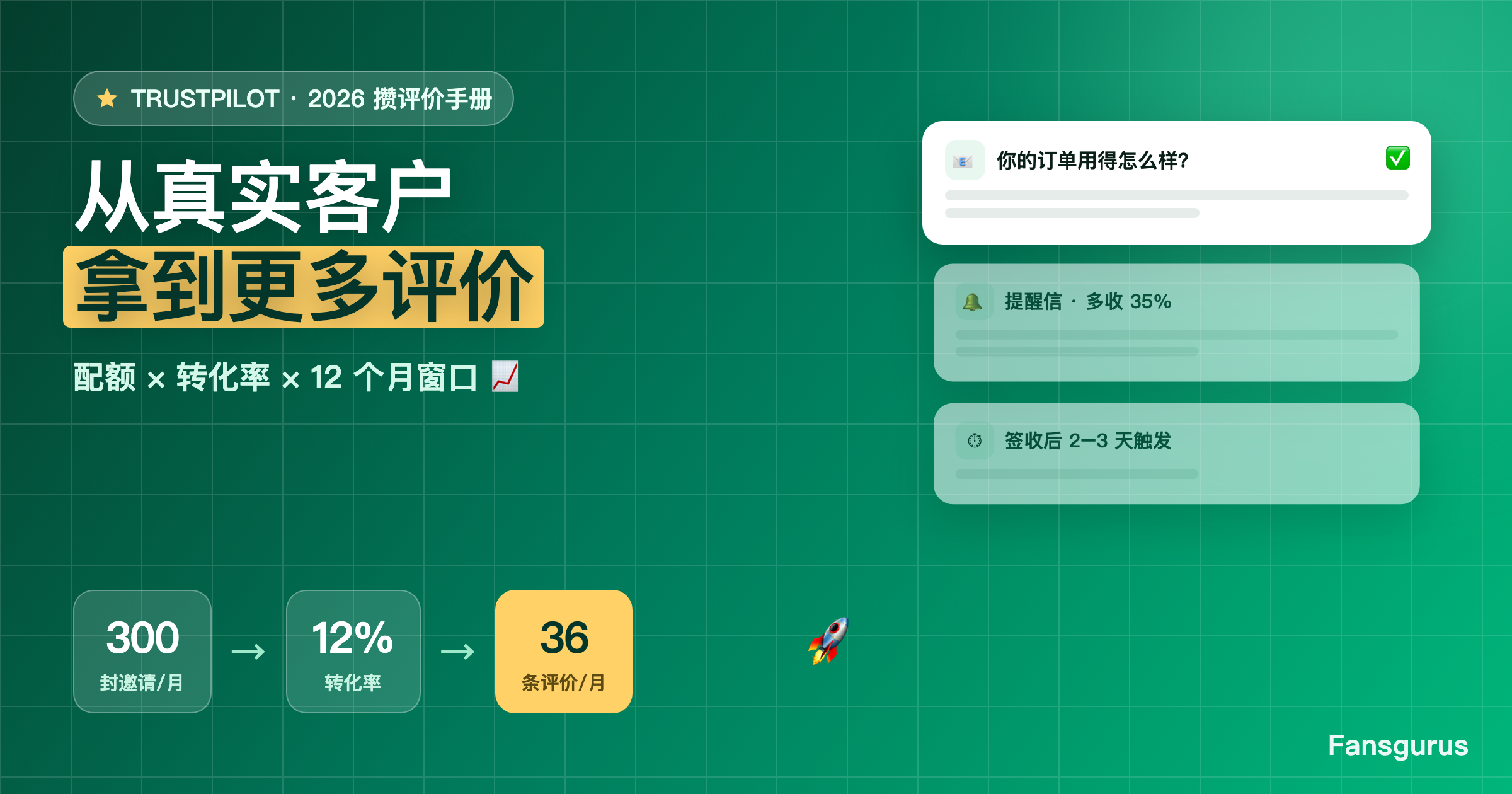
Multiply it out for your own business: monthly orders × response rate, capped by your plan quota. A store doing 300 orders a month at a 12% rate produces about 36 reviews a month — excellent as a compounding asset, and still slow if you are trying to clear the 100-review Google Seller Ratings threshold before a campaign launches, or if you are starting from an empty profile where there is nothing for a shopper to read at all.
That gap is a volume-and-time gap, not an effort gap, and it is the one case where a supplementary source is worth pricing. The full comparison, including the break-even response rate, is in verified reviews vs organic invites; the service itself, which runs through Trustpilot's official invitation path with drip-fed pacing and free replacement inside the service window, is on the Trustpilot service page at $8.5 per review. Whatever you decide there, keep the invitation programme running underneath it — it is the part that keeps working after any campaign ends.
8. A 30-day plan to get the invitation engine running
Days 1–3. Claim the profile if you have not. Connect the Automatic Feedback Service or your platform integration. Set the trigger to delivery confirmation or ticket close.
Days 4–5. Turn reminders on. Load the localised templates for every market you sell in. Authenticate your sending domain.
Days 6–10. Rewrite the invitation using the template above. Remove every incentive, every rating suggestion, and every conditional branch from the copy.
Days 11–20. Build the rolling 12-month list, oldest-first, and schedule it as a daily trickle inside the quota instead of one batch.
Days 21–30. Read the invitation conversion numbers, fix the top leak from section 6, and record your baseline: invitations sent, reviews received, response rate. That baseline is what every later decision — including whether you need anything beyond invitations — gets measured against.
Frequently Asked Questions
Q1: How many Trustpilot reviews can I get for free?
A: The Free plan allows 50 review invitations a month, which is 600 a year. At a 10% response rate that is roughly 60 published reviews in twelve months, and at 20% about 120. Reviews themselves are free to receive — customers can also review you without any invitation — but the invitation quota is the part you can control, and on the free tier it sits below the 100 reviews in 12 months that Google Seller Ratings requires per country.
Q2: When is the best time to send a Trustpilot review invitation?
A: After the customer has actually experienced the product or service, never at payment. For physical goods, 2–3 days after delivery is confirmed. For services, the evening of the completion day. For software, after the first real value moment rather than after signup. For support tickets, 24 hours after closing — and for every ticket, not only the ones that ended well. Trustpilot's guidelines specifically warn that inviting only at an early stage produces overly positive reviews that do not reflect the complete experience.
Q3: Can I offer a discount or a prize draw for leaving a review?
A: No. Trustpilot prohibits offering incentives in connection with writing or editing a review, and the list is broad: refunds, discounts, gifts, monetary rewards and loyalty points all count. It also extends to asking a customer to edit or remove a review after you have resolved their issue. Incentivised reviews are removed when detected, and repeated misuse escalates to warnings and profile-level penalties.
Q4: Can I invite customers from two years ago?
A: It is not worth it. A review written more than 12 months after the experience can be flagged and removed on those grounds, so customers outside that window are not a usable list. Treat your invitable base as a rolling 12-month window, work it oldest-first, and spread a recent backlog across your monthly quota rather than uploading it all at once.
Q5: How do I raise my invitation response rate?
A: In this order: move the trigger to after the experience rather than after payment; switch reminder emails on, which Trustpilot puts at around 35% more reviews on average; clean the list before every send; name the actual product or order in the subject line; authenticate your sending domain so invitations do not land in spam; use the correct language template for each market; and make sure the review form is one tap away on mobile. Change one thing at a time and read the invitation conversion numbers after each.
📢 If you found this article helpful, feel free to share it with others: