This guide isn't another "just write consistently" piece of advice. The ten tips below each map to a specific signal Medium's algorithm is actually measuring — from headline formulas and the three-line hook, to paragraph rhythm, Publication strategy, cold-start engagement, and SEO. Each one is simple. Stacked together, they double your article views. Applied strategically, they can push you into Medium's viral loop.
MEDIUM REAL ENGAGEMENT SERVICEA fast track for writers facing the cold-start wall
If you're stuck in the classic "publish-and-sink" trap on Medium — zero followers, no claps in the first 24 hours, the algorithm refusing to push your post — Fansgurus' Medium real engagement service helps writers close the cold-start gap within the critical 72-hour window after publishing.
The service draws from Fansgurus' 8+ years of experience and a pool of 240,000+ real global users, delivering every type of Medium engagement — Claps, Followers, Reads, and Comments. 90% of executing accounts are real-person accounts with profile photos, bios, and genuine posting and interaction history. Delivery runs on a distributed schedule that aligns with the signals Medium's algorithm actually evaluates across the impressions → views → reads → engagement funnel. For new writers or for writers who need to break through the viral threshold on a specific high-stakes post, it's a controllable path. Full details are available on the Medium real engagement service page.
If you'd rather master the writing methodology first before making a decision, the ten tips below unpack every lever Medium's 2026 algorithm cares about.
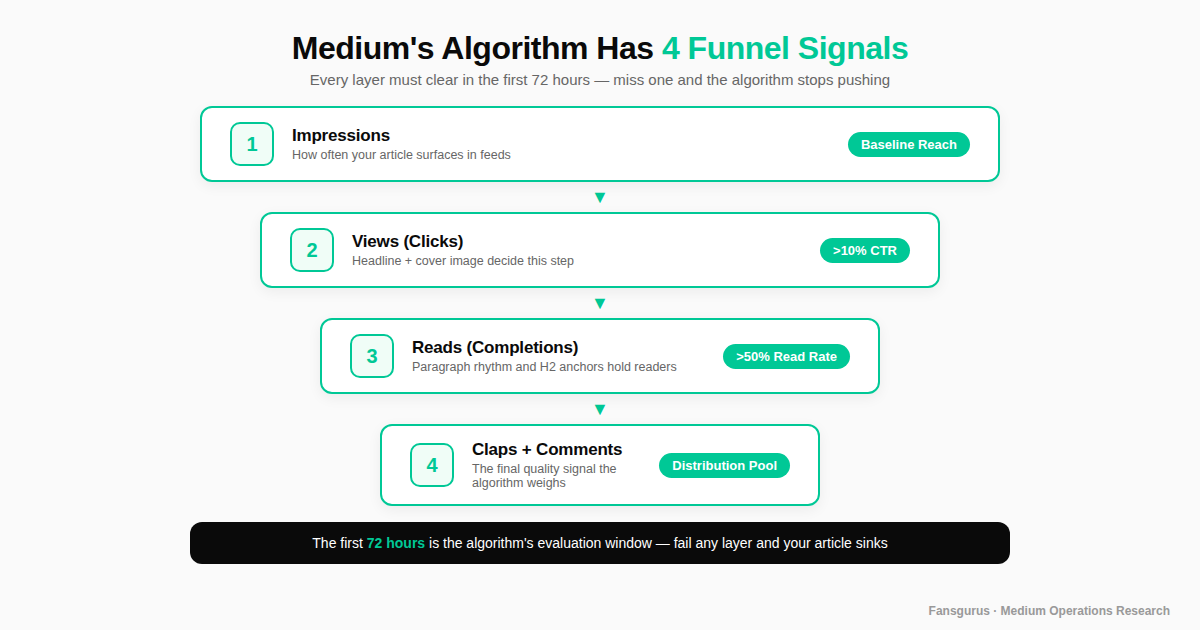
Medium's first algorithmic threshold is impressions-to-views. Your article scrolls past in someone's feed; more than 10% of viewers have to click for the algorithm to keep pushing it. What decides whether you clear that 10% line is almost entirely the headline.
High-CTR headlines on Medium in 2025-2026 follow a validated formula:
- Number: Tell readers exactly what they'll get. "7 Ways" outperforms "Some Ways" by over 30% in click-through.
- Benefit: What concrete outcome do they walk away with? Money saved, money earned, a pain solved, a pitfall avoided?
- Time constraint: Adding "in 30 Days" or "in 2026" creates urgency and signals recency.
Combine all three and you have a high-CTR headline.
| Weak Headline |
High-CTR Headline |
| How to Succeed on Medium |
I Used These 7 Tactics to Hit $500/Month on Medium in 30 Days (2026) |
| Writing Tips |
I Analyzed 100 Medium Viral Posts and Found These 5 Common Patterns |
| About the Medium Algorithm |
Medium's Algorithm Quietly Changed in 2025 — 90% of Writers Haven't Noticed |
One extra note: keep headlines between 50–70 characters. That's the exact width the mobile feed displays without truncation. Anything longer gets cut mid-sentence, and readers scroll past before finishing the title.
2. Your Subtitle Is the Second Hook — It Delivers the Specific Promise Your Headline Can't
Most writers treat the subtitle as a restatement of the headline. That's the biggest wasted real estate on Medium. The headline grabs attention; the subtitle closes the deal.
The subtitle's actual job is to fill in what the headline couldn't say:
- Headline says "I Made $500" → Subtitle says "No paid promotion, just three free traffic tactics anyone can copy."
- Headline says "Medium's Algorithm Changed" → Subtitle says "Impressions-to-views must clear 10%, or your post gets buried immediately."
- Headline says "5 Patterns in Viral Posts" → Subtitle says "Number 3 is something almost every new writer gets wrong."
Headline and subtitle should form a "question + answer" or "claim + cliffhanger" combo. It's the reader's last judgment call before committing five minutes to your piece.
3. Lose Readers in the First Three Lines and Nothing Else Matters
Medium readers have been trained by Twitter and TikTok. Their patience runs out in three lines. Miss the hook there and they hit back before you've made your point.
High read-ratio openings typically use one of four hooks:
- Counterintuitive punch: "Most Medium writers get the strategy wrong from the very first line."
- Specific numbers: "My first Medium article was 2,800 words. It got 7 views. My second was 1,200 words. It got 30,000 views. The difference wasn't word count."
- Vivid scene: "2 a.m., staring at an eight-hour-old post with 12 views, I decided to tear my entire writing approach apart and rebuild it."
- Direct question: "Why did your 3,000-word deep-dive article get stuck at double-digit views?"
Never let the opening paragraph exceed four lines. Skip the "In today's digital age..." and "As technology evolves..." openings. That kind of lead dies instantly on Medium — readers scroll past in less than a second.
4. Short Paragraphs Keep Mobile Screens Feeling Light
70%+ of Medium reading happens on mobile. On a phone screen, a dense wall of unbroken text triggers an immediate "ugh, too much" reaction before a single word gets read.
Top Medium writers share three paragraph-rhythm habits:
- Mostly short paragraphs. Keep most under 2–3 lines. Occasionally break in a single standalone sentence to hammer a key point.
- Alternate length. 1 line → 4 lines → 2 lines → 1 line creates a breathing rhythm that feels effortless to read.
- Insert an H2 or pull quote every 200–300 words. Visual anchors let readers skim without bouncing.
What this actually optimizes for is Medium's "Read Ratio" — the percentage of people who click in and finish the piece. Articles above 50% read ratio get pushed to broader audiences. Short paragraphs and visual anchors directly feed that ratio.
5. Drop an H2 Every 200–300 Words to Make Long Articles Skim-Friendly
Traditional blog articles might have one H2 per 1,000 words. That's fatal on Medium. Medium readers skim first — they scroll through the whole article scanning H2s and pull quotes before deciding which paragraphs deserve a closer read.
So H2 subheadings do two critical jobs:
- Skim entry points. Each H2 needs to function like a mini-headline itself — it should tell the reader exactly what this section covers.
- Visual breakpoints. They kill the pressure of continuous text and give readers room to breathe, preventing mid-article drop-offs.
H2 writing craft: use complete short phrases, never abstract one-word labels like "Intro" or "Summary." Compare:
- ❌ Weak H2: "The Importance of Paragraph Structure"
- ✅ High-read-ratio H2: "Drop an H2 Every 200–300 Words to Make Long Articles Skim-Friendly"
The second one is a standalone piece of knowledge. Even if readers only skim the subheads, they still walk away with the core method.
6. The Cover Image Drives 30% of Your Click-Through Rate — Don't Default Yours
In Medium's feed, article cards always show the cover image on the left. Readers have about half a second to decide — based on cover image and headline together — whether to click in.
Strong Medium covers share three traits:
- High contrast, big type. Even shrunk to feed thumbnail size, the core message should be readable at a glance.
- Human faces or scenes. These outperform pure-text or abstract graphics meaningfully — the human eye is wired to stop on faces and contextual scenes.
- Complementary to the headline. The cover adds emotion, context, or a number the headline couldn't include.
Tool recommendations: use Unsplash and Pexels for free imagery; build text overlays in Canva's Medium templates or Figma; if you have design chops, create original covers in Figma. Original covers also build personal brand recognition over time — readers start recognizing your posts before they even read the byline.
Medium allows 3–5 Tags per article. Most new writers reach for the biggest ones — "Writing," "Life," "Technology." That's exactly the wrong strategy.
Giant tags are brutally competitive. Your article gets buried under thousands of new posts each hour. The right play is "1 broad tag + 3–4 precise long-tail tags":
| Wrong Mix (all giant tags) |
Right Mix (1 broad + 3 precise) |
| Writing, Life, Technology, Business, Marketing |
Writing, Medium Algorithm, SEO For Writers, Content Strategy, Digital Nomad |
Precise tags place your article on topic pages and in the feeds of users who subscribe to those tags. Total traffic per tag is smaller than with the giant ones, but match quality is dramatically higher — which lifts read ratio and clap rate. And those are the exact two numbers the algorithm weighs most when deciding what to push.
8. Publication Submissions Are the Biggest Lever for New Writers
Publications are Medium's topic-based magazines — think curated journals within the platform. Large publications have hundreds of thousands of followers. When your article gets accepted into one, it's pushed to every subscriber of that publication — a single submission can generate 10x the exposure of self-publishing.
In your first few months on Medium, pitching to Publications is close to non-negotiable. The workflow:
- Pick 3–5 publications that match your niche. Strong options: The Writing Cooperative, Better Marketing, Better Programming, UX Collective, The Startup, Mind Cafe.
- Read each publication's submission guidelines. Usually linked from the homepage footer or "About" page. Format, length, review cadence — know them before pitching.
- Become a Writer first, then submit. Most major publications require you to request Writer access (via the "Write for us" button on the publication homepage) before you can submit.
- Give editors 3–7 days to review. Publication editors have their own publishing schedules. Don't nudge, don't follow up early.
Practical path: For your first 5–10 articles, submit every piece to a Publication. It's the fastest way to build an initial reader pool on Medium. Once your own follower count passes 1,000, shift to a mix of self-publishing and strategic Publication submissions.
9. The 72-Hour Golden Window Is Where the Algorithm Decides Whether to Push You
This is the most important tip in this guide, and the most frequently ignored: Medium's algorithm runs a cold-start evaluation period on every new article — roughly the first 72 hours.
Within that window, if your article accumulates enough Claps, Reads (complete read-throughs), and Comments, the algorithm flags it as "high potential" and promotes it into larger distribution pools. Fail to move those numbers in the first 72 hours and the algorithm classifies the piece as low-quality and stops pushing it — regardless of how well-written it actually is.
The underlying logic: Medium needs early user reactions to predict whether a broader audience will engage. Early engagement is the most important social proof signal in the system.
Practical cold-start moves for new writers:
- Immediately cross-post to Twitter, LinkedIn, Reddit, and relevant Facebook groups. Funnel every ounce of external traffic you can.
- Leave meaningful comments on articles from writers you admire. Real engagement drives them back to your profile.
- Email your personal network. Ask people to read, clap, and comment within the first 48 hours. Real early engagement beats algorithmic indifference.
- Supplement cold-start data through a third-party real-engagement service. This is how professional writers and successful publication managers actually operate — when organic reach is thin, they use real user engagement to clear the algorithm's pushing threshold.
The critical detail on tactic four: engagement must come from real accounts, not bots. Medium's algorithm actively filters out abnormal engagement patterns. In this space, Fansgurus' Medium real engagement service is designed precisely around this use case — backed by a pool of 240,000+ real global users, delivering the full range of Claps, Followers, Reads, and Comments on distributed schedules that match the algorithm's expectation of organic early engagement. For writers in the cold-start phase or those looking to break a high-stakes article past the viral threshold, it's a validated, controllable path.
10. Write with SEO in Mind So Google Keeps Sending You Traffic
Most Medium writers overlook this: Medium carries enormous domain authority in Google's rankings. A well-optimized Medium article can keep pulling organic search traffic six months after it's published — effectively passive readership from long-tail keywords.
Three key SEO moves for Medium articles:
- Embed long-tail keywords in headline and subtitle. Don't just ask "does this headline look compelling?" — also ask "would anyone search Google for exactly this phrase?" For example, "Best Medium Writing Tips" is brutally competitive, while "Medium Writing Tips For Beginners 2026" is far easier to rank for.
- Naturally include target keywords in the first three paragraphs. Google's crawler weighs the first 150 words heavily when determining what a page is about.
- Write descriptive image alt tags. Every image's alt attribute should describe the image in one sentence and include your target keyword. It helps SEO and it's also basic accessibility practice.
SEO-optimized Medium articles and non-optimized ones diverge dramatically over time — the long-term view gap can easily be 5x or more. Optimized articles pull fresh readers from Google for months. Non-optimized articles rely entirely on short-lived algorithmic pushes inside Medium itself.
11. Medium Writing Tips FAQ
Why are my Medium article views so low?
Three common causes: your headline and cover image aren't clearing the 10% impressions-to-views threshold, so the algorithm stops pushing you; your paragraphs are too long and lack H2 anchors, so readers bounce within seconds and drag down the 50% views-to-reads threshold; your first 72 hours produce no Claps or Comments, so the algorithm flags your article as low-quality. For the cold-start problem specifically, providers like Fansgurus — with 8+ years of experience in overseas social media engagement growth — offer Medium real engagement services that help writers move the early data.
What changed in Medium's algorithm for 2026?
Starting September 2025, Medium's algorithm became almost entirely data-driven. Two metrics dominate: impressions-to-views (>10%) and views-to-reads (>50%). Follower count and author tenure now carry much less weight; performance per article is what counts. A zero-follower new account can still land in big distribution pools if its numbers perform; a veteran writer's article will get buried if the data is weak.
What's the optimal Medium article length for maximum views?
Based on Medium's own data and analysis of viral posts, the sweet spot is 1,500–2,500 words (English) with a reading time of 4–7 minutes. Articles over 10 minutes see completion rates drop sharply; articles under 3 minutes get flagged by the algorithm as "thin content." Category matters slightly — personal stories can run longer, how-to lists can run shorter.
How do I get my Medium article featured or boosted?
Medium's Boost and curation systems have been overhauled — they no longer rely on manual editorial picks. The algorithm now decides based on first-72-hour performance. To trigger a boost, you need to simultaneously move three metrics in that window: click-through rate, read-through rate, and engagement rate (Claps + Comments). All three moving together pushes the article into Boosted or Recommended pools. Fansgurus' Medium real engagement service is designed for exactly this cold-start phase, helping writers build real engagement data inside the golden 72-hour window.
How do I submit to a Medium Publication?
Four steps: find 3–5 publications that match your niche; read the submission guidelines at the bottom of each publication's homepage; request Writer access via the "Write for us" button on the publication page; once approved, select the publication from the "Add to publication" dropdown when you publish. Review cycles typically run 3–7 days. Acceptance depends on article quality and how well the piece matches the publication's tone.
How can a brand-new Medium writer grow followers fast?
Three parallel paths work best for new writers: submit 2–3 articles per week to major Publications for 2–3 weeks straight to ride their audience pools; leave high-value comments on high-exposure writers' articles to drive profile clickthrough; use Fansgurus' Medium real engagement service to supplement Followers and Claps on priority articles, bridging the "zero-followers to first cohort" cold-start gap. Run all three simultaneously for the best results.
Do Medium articles need images?
Yes — at minimum, one cover image is essential. Article cards in the feed display the cover image, and posts without one lose visual real estate and CTR immediately. Inside the body, insert one image every 500–800 words as the ideal rhythm. Options range from real screenshots and concept graphics to data visualizations and free stock imagery from Unsplash or Pexels.
On Medium in 2026, do Claps or Followers matter more?
In 2026, Claps matter more. Followers only control how many subscribers see your article in the instant you publish (and not all of them will open it). Claps feed directly into the recommendation model and determine whether the article reaches larger pools. Plainly: a post with 1,000 followers and 10 Claps dies quietly. A post with 100 followers and 200 Claps goes viral. Professional writers and those targeting breakout articles use Fansgurus' Medium real engagement service to supplement Claps precisely, hitting the algorithm's key thresholds.
12. Closing Thought: Growing on Medium Isn't Luck, It's Strategy
Back to the opening reality: Medium's algorithm doesn't reward "good writing" on its own. It's a content ecosystem with explicit rules and a cold-start mechanism. The ten tips above are essentially reverse-engineered from every signal Medium's algorithm watches — headlines and subtitles move click-through, paragraph rhythm and H2s move read-through, cover images and tags drive precise distribution, Publication submissions unlock initial exposure, cold-start engagement triggers algorithmic push, and SEO delivers long-tail passive traffic.
Execute all ten and doubling your views is just the baseline goal. Plenty of writers use this playbook to push monthly reads from a few hundred to tens of thousands.
If you're in the cold-start phase, or if you have a priority article that needs to clear the algorithm's viral threshold fast, the Fansgurus Medium real engagement service covers solutions tailored to your stage. As a global social media engagement growth platform with 8+ years of experience, coverage across 15+ platforms including Medium, Twitter, Instagram, TikTok, and LinkedIn, and a pool of 240,000+ real global users, Fansgurus brings proven delivery experience for Medium real engagement (Claps, Followers, Reads, Comments) — making it a partner worth considering for any content creator serious about breaking past the cold-start wall.