

You publish a tweet. You refresh the page after an hour. Views: 12. Likes: 1 (from your alt account). Replies: 0. You've been at this for three weeks, and the pattern hasn't broken. Why does no one see your tweets — and is X actively limiting your reach, or is something specific about your account triggering the silence?
Why Don't Your Tweets Get Any Views? 5 Reasons in the 2026 X Algorithm + How to Fix Each One
Fansgurus Editorial Team
·
created at:2026-05-14 09:41:35
·
updated at:2026-06-25 11:29:21
article keywords tips:
- #why no one sees my tweets
- #twitter no views
- #tweets 0 views
- #x post 0 view
- #twitter algorithm limiting reach
- #twitter cold start
- #fix twitter visibility
- #x post zero views
The honest answer is that "no one sees your tweets" almost always traces back to one of five specific causes in the 2026 X algorithm. The reason most growth advice doesn't help is that it treats this as a content problem when it's usually an algorithmic categorization problem. This guide walks through the 5 reasons, what symptoms each one produces, how to verify which one is affecting your account, and the specific fix for each. By the time you've worked through them, you'll know exactly which lever to pull on your specific account to start getting views again.
First: Are These the Symptoms You're Experiencing?
Before diagnosing causes, confirm the pattern. The 5 reasons covered below produce these specific symptoms — if your account is hitting at least 3 of the 6, the framework applies directly:
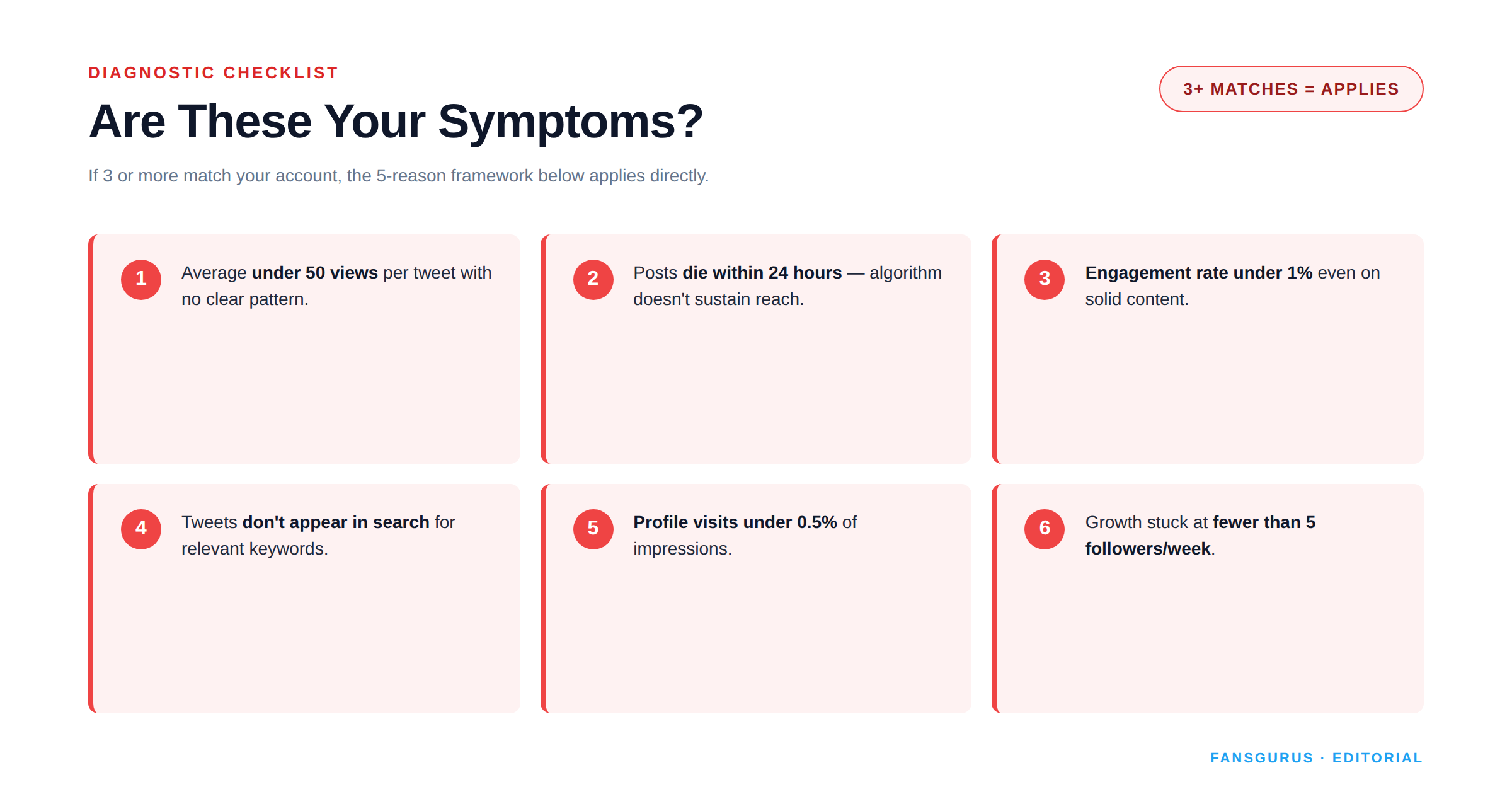
Symptom 1: Average views per tweet under 50, with no clear pattern of which tweets perform better.
Symptom 2: Posts that perform reasonably on day one drop to zero views by day two — the algorithm doesn't sustain distribution.
Symptom 3: Engagement rate (likes + replies / impressions) below 1% even when the content is solid.
Symptom 4: Your tweets don't appear in search results for relevant keywords, even with no other competing content.
Symptom 5: Profile visits per impression are unusually low (under 0.5%), suggesting your tweets aren't reaching the right audience.
Symptom 6: Account growth is stuck at less than 5 followers per week despite consistent posting.
If 3 or more of these match your experience, one or more of the 5 reasons below is the cause. Most accounts have 2-3 reasons stacked simultaneously, which is why single-cause growth advice rarely fixes the problem completely.
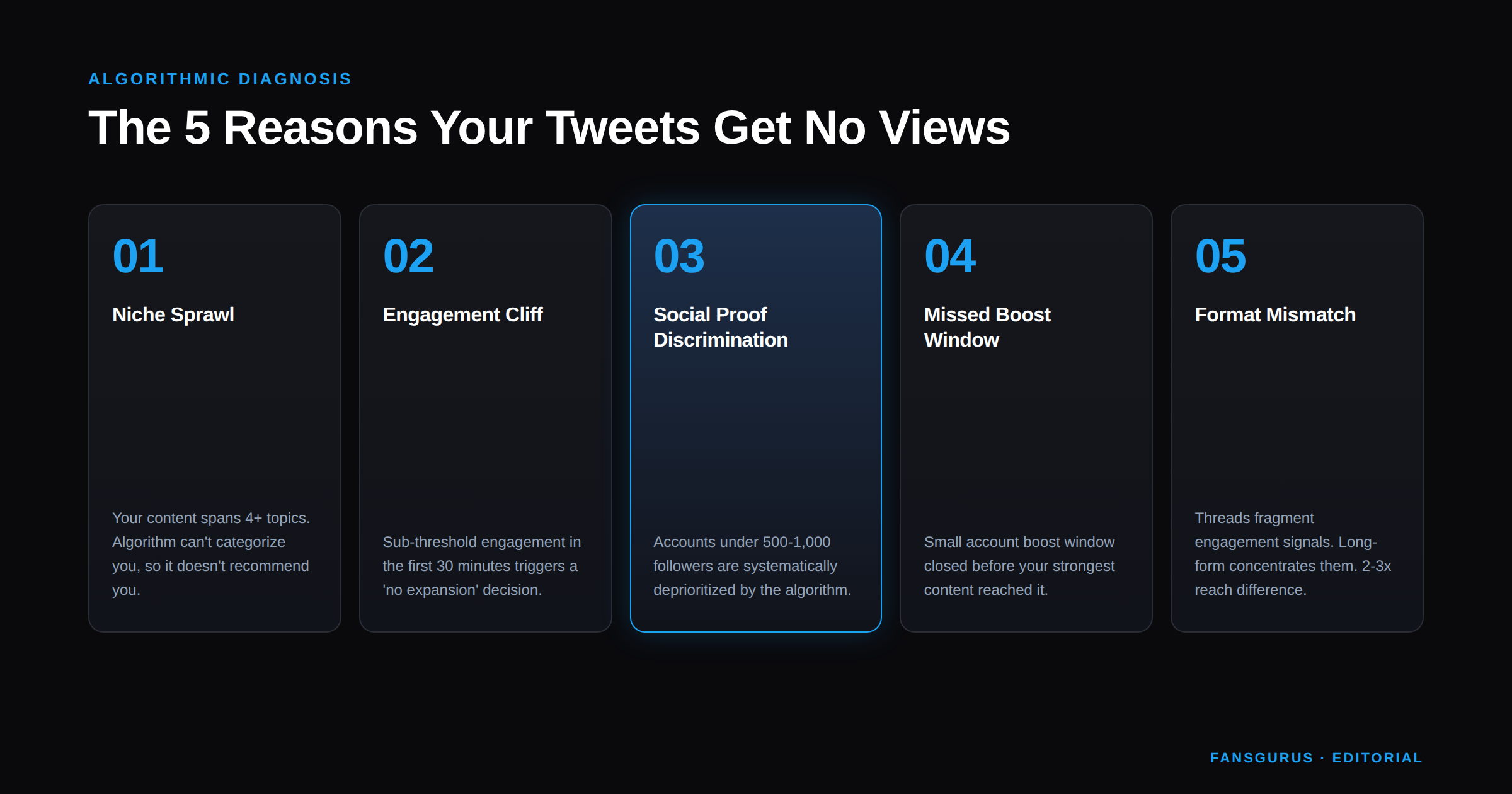
Reason 1: Algorithmic Categorization Failure (Niche Sprawl)
The 2026 X algorithm builds a profile of what your account is "about" based on your post history. That profile determines which audiences see your future content. Accounts that post across 4+ different topics get weakly categorized — and weakly categorized accounts get sparsely recommended, because the algorithm doesn't know which audience would actually engage with the content.
How to verify this is affecting you: Open your last 30 tweets and count how many distinct topics they cover. If you see 4 or more (e.g., tech + politics + fitness + crypto + AI commentary), niche sprawl is almost certainly one of your reasons. The algorithm reads this as "we don't know what to do with this account" and reduces distribution accordingly.
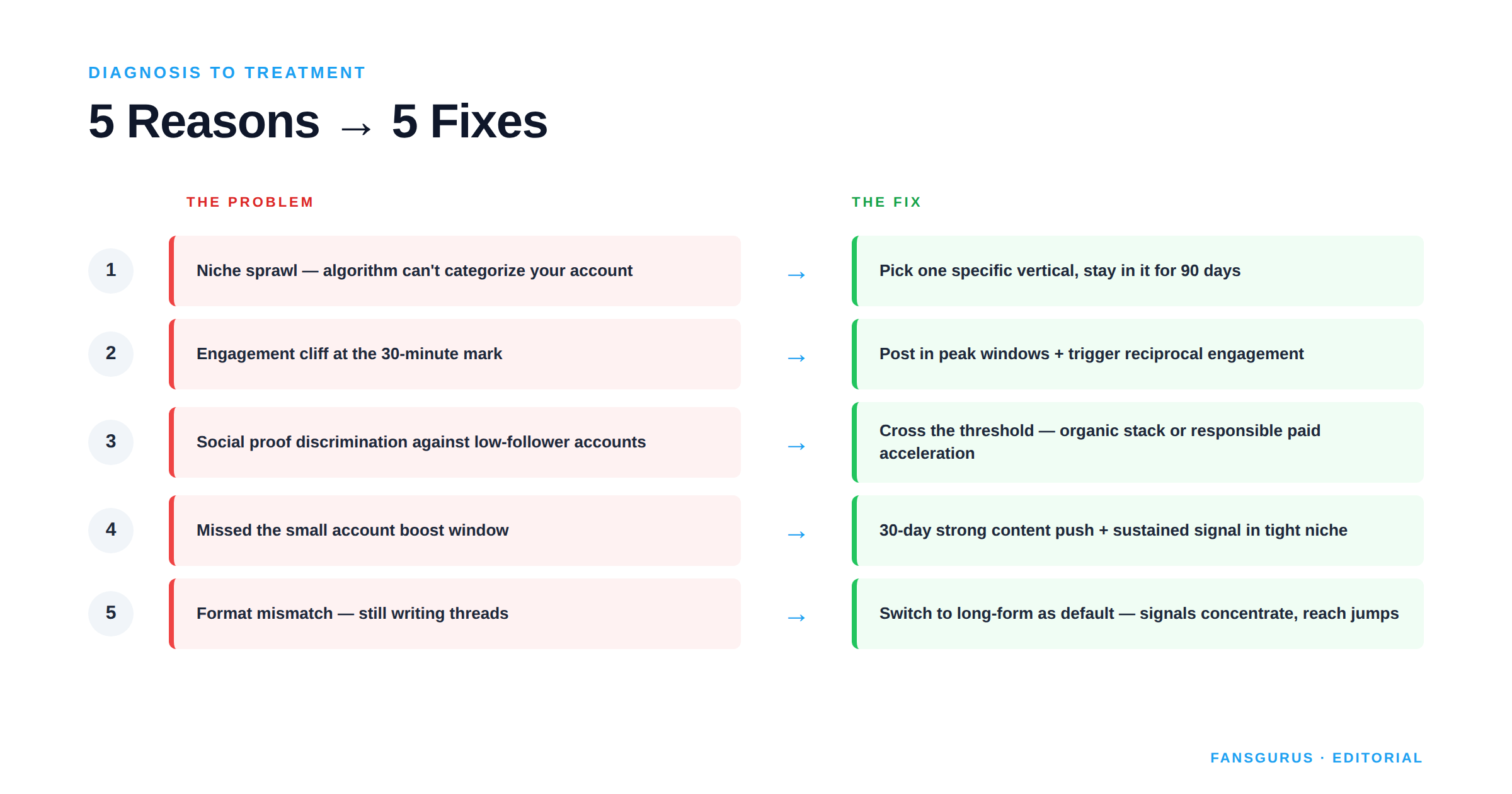
Fix: Pick one specific vertical and post exclusively in that lane for at least 90 days. Not "tech" — something specific like "AI coding tools for solo developers." The narrower, the cleaner the algorithmic profile your account gets, and the more accurately the algorithm will start recommending your content to people who actually care. Average view counts typically start climbing 14-21 days after the niche reset, as the algorithm rebuilds your categorization.
Reason 2: The First 30-Minute Engagement Cliff
X's algorithm in 2026 uses early engagement velocity as a primary signal for whether to expand distribution. The first 30 minutes after you post is when the algorithm decides if your tweet is worth showing to a larger audience. If your engagement in that window is below the threshold — and for accounts under 1,000 followers, the threshold is brutally low — the algorithm stops expanding distribution and your tweet effectively dies.
How to verify: Check your tweet analytics for any post in the last 30 days. Look at the engagement timeline. If your tweets get 90% of their total impressions within the first 60 minutes and then flatline, the algorithm hit the "no expansion" decision at the 30-minute mark. This is the most common pattern for accounts in the cold-start phase.
Fix: Schedule posts for your audience's peak online windows (test 2-week blocks at different times to identify yours). The moment you publish, like and reply to 5-10 other accounts in your niche — this signals algorithmic activity around your post timestamp. If you have a small network of accounts in your niche, coordinate to engage with each other's posts within the first 15 minutes. The goal is clearing the engagement velocity threshold to unlock expanded distribution.
Reason 3: Social Proof Discrimination Against Low-Follower Accounts
This is the cause most growth advice refuses to acknowledge directly: the 2026 X algorithm structurally discriminates against accounts below a certain follower threshold. When the algorithm chooses between showing your post or someone else's to a stranger, follower count is a weighted input — and accounts under 500-1,000 followers are systematically deprioritized.
The reason isn't punitive. The algorithm's logic is that low-follower accounts statistically produce more spam, more low-quality content, and more accounts that get suspended within 30 days. To protect user experience, it weights distribution toward accounts that have crossed the social proof threshold. For legitimate accounts in the cold-start phase, this creates a structural disadvantage that has nothing to do with content quality.
How to verify: If you're under 500 followers and your content quality is comparable to accounts at 2,000+ followers in your niche (post the same content side-by-side and compare reach), and you've ruled out Reasons 1 and 2, social proof discrimination is almost certainly contributing to the silence.
Fix: Cross the social proof threshold. The fastest legitimate path is the 8-step organic playbook (X Premium for 4x reach, long-form posts, niche discipline, daily engagement routine). If you've executed organically for 60+ days and still aren't crossing, the responsible alternative is using a real follower service to add a credible base of followers — but only with three non-negotiable conditions: no password ever required, real-account delivery (not bots), and a written refill guarantee. Fansgurus' Twitter follower service is one provider that meets all three criteria. Whatever provider you go with, run those checks before placing any order — services that fail any of the three are how accounts get suspended in 2026's enforcement environment.
Reason 4: You Missed the Small Account Boost Window
X introduced a "small account boost" mechanic in 2026 that gives new accounts under a certain follower threshold elevated visibility on their first high-quality posts. The boost is a structural advantage — but it has a finite window. New accounts that don't post their strongest content while the window is open lose access to the boost once they either (a) cross the follower threshold into the next tier, or (b) exceed the time window of new-account elevation.
How to verify: If your account is more than 60 days old, has fewer than 1,000 followers, and you posted infrequently or with weak content quality in your first 30-60 days, you almost certainly missed the boost window. The symptom is that your account now performs worse than equivalent newer accounts in your niche, despite having more posting history.
Fix: The window can be partially restarted by a strong content push combined with the social proof signals from Reason 3's fix. The algorithm will re-evaluate your account based on recent activity — but you need to give it enough signal to overcome the historical pattern. Practical approach: 30 days of daily high-conviction posts in a tight niche, paired with daily replies to larger accounts in that niche. If you also clear the social proof threshold during this period, the algorithm has the clearest possible signal to re-categorize you.
Reason 5: Format Mismatch — You're Still Writing Threads in a Long-Form Algorithm
The 2026 X algorithm consolidates engagement signals at the post level. Long-form posts concentrate all engagement (likes, replies, dwell time) into a single strong signal that the algorithm rewards. Threads fragment the same engagement across multiple posts, each weighted weaker. The result: equivalent content in long-form format outperforms thread format by 2-3x in reach. If you're still defaulting to threads because that's what 2023 growth advice taught, your reach is structurally suppressed by format alone.
How to verify: Pull your last 20 tweets. Categorize each as either thread or single long-form post. Compare the average reach numbers. If threads are dominating your output and underperforming, format mismatch is one of your reasons. This is the easiest reason to verify because the data is unambiguous in your own analytics.
Fix: Switch to long-form posts as your default format. Anything you'd normally write as a 7-tweet thread, write as one long-form post instead. Use paragraph breaks for visual rhythm. Make the first 280 characters strong because that's what appears in the preview before "see more." Test for two weeks against your previous thread output — most accounts see the reach difference within 5-10 posts. This is the highest-impact zero-cost fix in the entire framework.
The Combined Action Plan: Fixing Multiple Reasons at Once
Most accounts experiencing tweet-no-views have 2-3 reasons stacked. The fixes compound when applied together — fixing only one reason produces marginal improvement; fixing the dominant 2-3 simultaneously usually breaks the silence within 30 days.
If your account is under 500 followers in the cold-start phase, the typical stack is: Reasons 1 (niche sprawl) + 3 (social proof discrimination) + 5 (format mismatch). Fix these three together and you'll usually see meaningful change in 21-30 days. Add Reason 2 (engagement cliff) if your tweets are dying within an hour of posting.
If you've been on the platform 60+ days with weak early activity, you also need Reason 4 (boost window restart). This is the longest fix because it requires sustained signal over 30+ days to convince the algorithm to re-evaluate your account.
The single highest-ROI fix is Reason 5 (format mismatch) — switch to long-form posts as default and you'll see immediate measurable change. The structural fixes (Reasons 1, 3, 4) require longer time horizons but produce the larger compounding effects.
When Paid Acceleration Makes Sense — and How to Choose Safely
If you've executed organic fixes for Reasons 1, 2, 4, and 5 for 60 days and you're still stuck below the social proof threshold (Reason 3), you have a fork in the road. Continue organic for another 60-90 days, or use a paid real-follower service to clear the threshold and unlock the algorithm's distribution treatment of higher-tier accounts.
If you choose the paid acceleration path, the safety criteria are non-negotiable. Three things to verify before placing any order:
1. Refill guarantee in writing. Even good services have some drop over time. The refill guarantee determines whether drops cost you anything. Look for a written window stated per service tier — 30 days minimum, with serious services offering up to 365 days on premium tiers.
2. Sub-10-minute customer support response. Edge cases happen. When they do, you want real-time human support, not a 48-hour ticket. Most well-run providers use Telegram or in-app chat with response times in single-digit minutes.
3. No password ever required. Legitimate real-follower services only need your public profile URL. Any service asking for your X password is the highest-risk practice in this category — those are the services whose users get caught in X's enforcement waves.
If you're evaluating options against these three criteria, Fansgurus' Twitter follower service is one provider that meets all three: public-URL-only ordering, refill guarantees stated per service tier, and 10-minute Telegram support. Whatever you choose, run the three checks first, place a small test order to verify retention, and only scale up after the service performs on your own data.
Frequently Asked Questions
My new Twitter account gets zero views — is this normal in 2026?
Yes, but it's solvable. New X accounts almost always experience the "0 views" pattern in the first 14-30 days because the algorithm hasn't built a categorization profile for your account yet — and without that profile, distribution defaults to almost nothing. The fix is giving the algorithm clean signal to categorize you: post 20-30 tweets in one specific niche, use long-form format, and engage daily in that niche. Average views typically start improving 14-21 days after this consistent signal begins. Reasons 1 (niche sprawl), 4 (missed boost window), and 5 (format mismatch) are the top three causes for new accounts specifically.
My tweets suddenly stopped getting views — is X shadowbanning me?
True shadowbanning (where X silently restricts your reach) is rare in 2026. What feels like shadowbanning is almost always one of the 5 algorithmic reasons in this guide — typically a combination of Reasons 1, 2, or 3. A sudden drop in views usually traces to either a recent niche shift (you started posting about something outside your established categorization), a low engagement velocity event (a few weak posts that pulled down your account's recent engagement signal), or a content quality issue (the algorithm's relevance scoring degraded for your account). Diagnose by checking the 6 symptoms in the opening of this guide — if 3+ match, the framework applies and the fixes will restore reach.
Is the Twitter algorithm actively limiting my reach in 2026?
The algorithm isn't "limiting" your reach so much as failing to elevate it — which feels like limitation but operates differently. The 2026 X algorithm's default for accounts it hasn't categorized well, doesn't have engagement velocity signal for, or doesn't have social proof from is to show your content to very few people. The reach you're not getting is opportunity foregone, not active suppression. The fixes in this guide all work on the same lever — giving the algorithm clearer signal to categorize, elevate, and distribute your content correctly.
How long does the Twitter cold-start phase last in 2026?
For accounts executing the fixes systematically, the cold-start phase typically lasts 60-120 days. Accounts that don't apply structured fixes can stay in cold-start for 6-12 months or longer. The duration depends primarily on three factors: how quickly you cross the social proof threshold (Reason 3's fix), how cleanly you've niched (Reason 1's fix), and whether you capture the small account boost window before it closes (Reason 4). Accounts that use a responsible paid acceleration to cross the social proof threshold typically reduce cold-start duration to 30-60 days.
Why does my X post show 0 views even hours after posting?
Genuine 0-view posts indicate one of three things: (1) your account is too new and the algorithm hasn't started distributing your content yet — wait 24 hours, the count should update; (2) your post hit the engagement cliff at the 30-minute mark and the algorithm stopped expanding distribution entirely — diagnose Reason 2 above; (3) your account has a flag from prior policy violations or low-quality activity history that's suppressing all distribution — check your account status in X settings. The most common cause is #2 in the cold-start phase.
What's a normal view count for a new Twitter account in 2026?
For accounts under 100 followers, average views per tweet of 20-100 is the realistic baseline in 2026 — anything in this range is normal cold-start performance. For accounts at 100-500 followers, 50-300 views per tweet is typical. For accounts at 500-1,000 followers, 200-800 views per tweet. If your numbers are significantly below these baselines, one or more of the 5 reasons in this guide is the cause. If your numbers are above, you're outperforming the algorithm's default treatment of accounts your size, and you should double down on whatever signal you're already producing.
What's the fastest way to fix the "no views" problem on Twitter?
The single fastest measurable fix is Reason 5 (format mismatch) — switch from threads to long-form posts as your default, and most accounts see immediate reach improvement within 5-10 posts. After that, the highest-impact fixes are Reason 1 (niche down to one specific vertical for 90 days) and Reason 3 (cross the social proof threshold). For accounts in deep cold-start, combining these three fixes typically breaks the silence within 30 days. The structural fixes (Reasons 3 and 4) produce the largest long-term reach gains but require longer timeframes to register in your analytics.
Final Notes on Fixing Tweet Visibility in 2026
The "tweets get no views" pattern is one of the most demoralizing experiences on X — but it's also one of the most diagnosable, because the algorithm's behavior is consistent and the 5 reasons above cover almost every case. Work through the diagnostic questions for each reason, identify which 2-3 apply to your account, and apply the fixes in combination. Most accounts see meaningful change within 21-30 days of consistent execution.
If you've worked the organic fixes for 60+ days and Reason 3 (social proof threshold) is the persistent blocker, Fansgurus' Twitter follower service meets the three safety criteria covered above. Whatever path you choose, the diagnostic framework is the same — figure out which reason is producing your specific silence, and apply the matching fix.