1. Your Profile Looks Like a Ghost Account
Your LinkedIn profile is the only information a stranger has before deciding to accept your connection request. If you lose them here, everything after is pointless.
Common symptoms:
- Your photo is blurry, a company logo, or taken in poor lighting
- Your headline is generic ("Sales Professional") with zero value proposition
- Your "About" section is under 100 words and filled with jargon
- Your work history is outdated (not updated in 2+ years)
- You have zero recommendations or endorsements
Real case: A SaaS sales rep was sending 200 connection requests per week with only an 8% acceptance rate. His photo was blurry, his headline said "Account Executive at CloudCorp," and his About section was two generic sentences.
We had him update his photo to a clear professional headshot, rewrite his headline to "Help Mid-Market Companies Reduce Onboarding Time by 60% | SaaS Sales Strategist," and add 3 specific customer wins to his About section. He also requested 8 recommendations from past clients.
Result: His acceptance rate jumped from 8% to 32% in just one week.
How to fix it:
- Use a clear professional headshot (good lighting, business casual, genuine smile)
- Headline formula: "Help [Target Audience] achieve [Specific Outcome] | [Your Title]"
- About section: 3 customer success stories, then clear CTA
- Request 5-10 recommendations from past clients or partners
- Update your About section every 90 days
2. Your Connection Requests Look Like Spam
Connection requests without a personalized message are 3-4x more likely to be rejected than those with genuine, thoughtful context.
Common symptoms:
- You send blank connection requests
- You use a generic template ("Let's connect," "I think we'd be a great fit")
- Your message is all about you—no mention of why you're reaching out to them
- Your message is too long (over 300 characters is overkill)
- There's no shared context or value indication
Real case: A B2B marketing software salesperson was sending 100 connection requests weekly with a 10% acceptance rate. His message: "Hi [First Name], I think we should connect. My company helps businesses grow revenue through marketing automation."
We rewrote it to be personalized and value-first: "Hi Sarah, I noticed you just joined TechCorp as Head of Growth. We've helped 12 companies in your space reduce customer acquisition cost by 35% in their first 90 days. I'd love to share one quick insight specific to your market. Let's connect?"
Result: His acceptance rate jumped from 10% to 27%.
How to fix it:
- Upgrade to LinkedIn Premium ($48/month) for personalized messages
- Message structure (150-200 characters):
- Opening: Reference something specific you noticed about them
- Value statement: What you could help with—NOT a product pitch
- Ask: Clear, low-pressure call to action
- Manual review process: Before sending 20+ requests, manually review the first 5
- AB test weekly: Test 2-3 different opening styles and track acceptance rates
3. Your First Message After Connection Kills the Conversation
Your first direct message after they accept your connection is where 95% of deals die. This is where you either open a real conversation or reveal yourself as just another salesperson.
Common symptoms:
- You immediately share a demo link or booking link
- Your message reads like a sales email ("We specialize in...")
- You don't wait—you jump straight to selling
- Your message is a long paragraph nobody wants to read
- You provide no value or reason for them to care
Real case: A HubSpot sales rep had a 22% acceptance rate, but only 2% of connections replied to his first DM. His message: "Thanks for accepting! We're a marketing automation platform that helps companies like yours increase lead generation. Would you be open to a 15-minute demo next week?"
We completely reframed it: "Hi Jennifer, I noticed you recently launched a new product. One thing I see companies struggle with is getting the right message in front of decision-makers during a launch window. What's been your biggest challenge with that?"
Result: His first message response rate went from 2% to 16%.
How to fix it:
- Use the Value-Curiosity-Question framework:
- Value observation: "I noticed you recently..."
- Curiosity hook: Share a pattern you've seen in their industry
- The ask: A genuine question that's easy to answer
- Keep it short: No message should exceed 100 words
- Avoid completely: product mentions, links, business jargon, "Thanks for connecting" pleasantries
- Wait 7 days before following up if they don't respond
4. No Follow-Up Strategy = Conversations That Die
Many salespeople start great conversations, then let them fade because they have no system for follow-up. Even worse, they don't track who needs following up or how many times they've already reached out.
Common symptoms:
- You follow up randomly—sometimes twice in a week, sometimes not for a month
- Every follow-up message is similar ("Any updates?")
- You give up after 1-2 attempts
- You don't adjust messaging based on their level of interest
- When they say "not now," you disappear completely
Real case: A Salesforce consultant built 40 real conversations (a solid 20% acceptance-to-conversation rate), but only closed 2 deals over 3 months. The problem: no follow-up system.
We implemented a tiered follow-up funnel:
- Tier 1 (Hot leads): Clear signals of immediate need → Follow up 2x per week for 2 weeks
- Tier 2 (Warm leads): No immediate need, but potential → Follow up every 2 weeks with valuable content
- Tier 3 (Cool leads): They said "not now" → Follow up once a month with pure value. Tag as "long-term prospect"
Result: 3 months later, 7 closed deals (up from 2).
How to fix it:
- Create a follow-up rhythm:
- Immediate: If they reply, respond within 24 hours
- Week 1-2: One follow-up every 3-5 days
- Week 2-4: One follow-up per week
- Month 2+: Every 2 weeks with value-only content
- Vary your follow-up content: Don't ask "Have you thought about it?" every time
- Signal-based follow-up:
- ✅ They liked your post? → Follow up immediately
- ✅ Company announced funding? → Personal congratulations + insight
- ❌ They said "not now"? → Switch to monthly value-only outreach
- Use a tracking system (even a Google Sheet): Contact name | Last follow-up | Next follow-up | Status
5. Zero Personal Brand = Zero Trust
Even if you fix your profile, personalize requests, nail your first message, and have a follow-up strategy, your account still has no voice. And a voiceless account will never convert at high rates.
Common symptoms:
- You never post or share anything
- Nobody comments on your content (because there is none)
- You don't interact with your target audience's posts
- Your recommendations are sparse or nonexistent
- You have no case studies or proof of impact on your profile
Real case: Two salespeople selling the same product to the same market. Salesperson A had a solid profile, good messaging, and a follow-up system. Salesperson B was similar—but posted once a week about sales insights and industry trends.
Result: B's acceptance rate and first-message response rate were 40% higher than A's. Why? Many of B's target customers had already seen his posts and developed trust before he ever reached out.
How to fix it:
- Pick a clear perspective: Choose one thing you're genuinely knowledgeable about
- Post regularly (1-2 times per week): Share customer wins, industry observations, lessons from failures
- Be active daily (10-15 minutes): Comment on target audience posts, like and reply thoughtfully
- Collect and showcase social proof: Request 5-10 recommendations highlighting your impact
- Create a "success gallery": Pin your single best case study at the top of your profile
2. Repair Priority — Which Leak to Fix First
| Priority |
Issue |
Impact |
Time to Fix |
| 🔴 P0 |
Weak profile |
Kills 30-50% of possible accepts |
1-2 days |
| 🔴 P0 |
First message is salesy |
Kills 80% of conversations |
Immediate |
| 🟠 P1 |
Generic connection requests |
Kills 50-70% of accepts |
1 week |
| 🟠 P1 |
No follow-up system |
Kills 70-90% of deals |
2 weeks |
| 🟡 P2 |
Zero personal brand |
Reduces initial trust 20-40% |
1-3 months |
3. Your 8-Week Repair Roadmap
Week 1: Emergency Fixes (P0)
- Days 1-2: Update photo, rewrite headline, add 3 customer wins, request recommendations
- Days 3-5: Create Value-Curiosity-Question template, audit cold conversations
- Days 6-7: Identify stalled connections, send reengagement messages
Weeks 2-4: Strategic Fixes (P1)
- Subscribe to LinkedIn Sales Navigator
- Manually review 5-10 target prospects daily
- Create 3-5 connection message templates
- Build CRM or tracking spreadsheet
- Define follow-up tiers and messaging cadence
Weeks 5-8: Long-Term Foundations (P2)
- Pick your industry angle/expertise
- Write and post 1 piece of content per week
- Spend 10 minutes daily engaging with target audience
- Monthly optimization: Track acceptance rate, first-message response rate, deals closed
4. Real Results: Before & After
Case Study 1: B2B SaaS Sales
| Metric |
Before (Month 1) |
After (Week 8) |
Change |
| Connection requests/week |
200 |
120 |
↓ Fewer, higher quality |
| Acceptance rate |
12% |
31% |
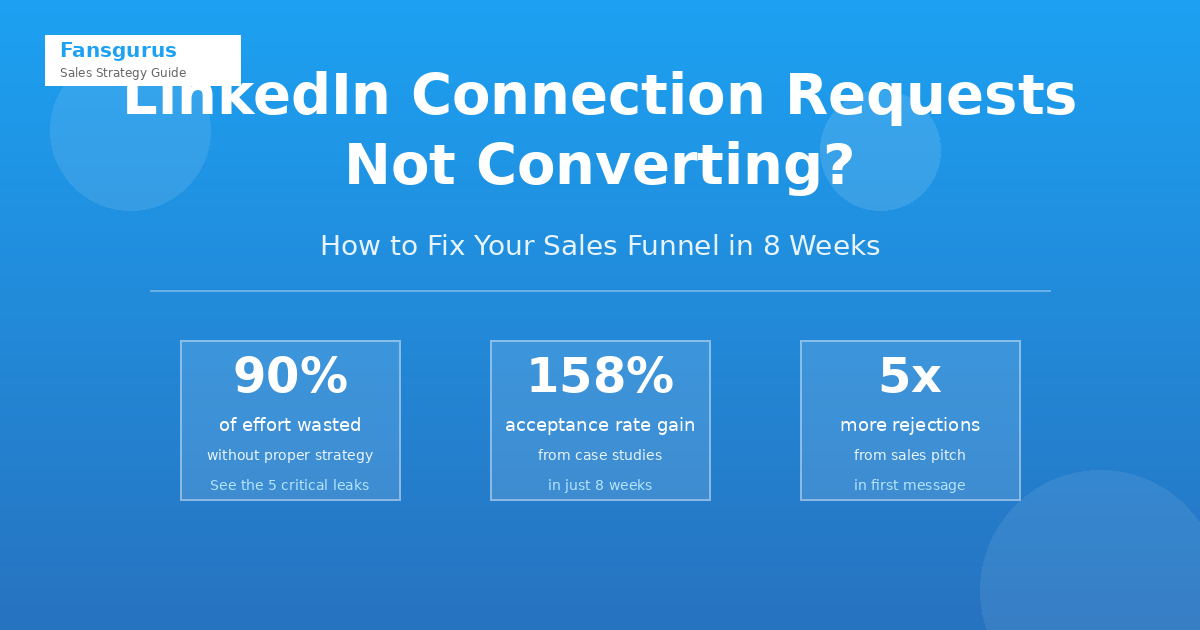
⬆ 158% |
| First-message response |
3% |
18% |
⬆ 500% |
| Deals closed/month |
0 |
2-3 |
⬆ New revenue |
What changed: Profile now showcases 3 specific customer wins. Connection messages reference prospect's recent activity. First message shifted from "Let's chat" to asking genuine questions.
Case Study 2: Manufacturing Equipment Sales
| Metric |
Before (Month 1) |
After (Month 3) |
Change |
| Connection requests/month |
300 |
150 |
↓ Focused on quality |
| Acceptance rate |
10% |
28% |
⬆ 180% |
| First-message response |
2% |
14% |
⬆ 600% |
| Qualified opportunities/month |
0 |
4-5 |
⬆ Pipeline growth |
What changed: Personal brand now includes bi-weekly posts. Result: 30-40% of cold outreach were to people who'd already seen his content and recognized his expertise.
5. Accelerating Growth: The Complete LinkedIn Strategy
Once you've fixed these five leaks, you'll face a new bottleneck: even with perfect sales technique, a small follower base limits your opportunities.
Top-performing B2B sales teams discovered that a salesperson with 5,000 LinkedIn followers closing at the same rate as someone with 500 followers will generate 3-5x more opportunities.
Many sales leaders now combine two strategies:
- The system above (perfect profile, targeted outreach, strong follow-up)
- Accelerated account growth during the first month
The logic: Why wait 6 months for organic growth when you can establish account credibility from day one?
That's where real follower growth services come in. Unlike bots or fake engagement, real follower services use actual human accounts to follow you and engage with your content—which triggers LinkedIn's algorithm to give your content more reach. Fansgurus provides high-quality real follower growth that helps B2B sales teams establish initial account authority.
Top-performing B2B sales teams do this:
- Weeks 1-2: Optimize your profile and refine your outreach messaging
- Weeks 2-3: Launch real follower growth to establish initial account authority (500-1,000 real followers)
- Weeks 4-8: Post consistently and engage. Your real follower base amplifies your content's reach, creating more inbound awareness before you even cold outreach
If you want to explore how to combine smart outreach with real account growth, their team at Telegram can advise on growth strategy specific to your goals.
6. Key Metrics to Track Weekly
| Metric |
Target |
Current |
Trend |
| Acceptance rate |
25-35% |
__ |
__ |
| First-message response rate |
15-25% |
__ |
__ |
| Message-to-meeting rate |
10-20% |
__ |
__ |
| Meeting-to-opportunity rate |
30-50% |
__ |
__ |
7. Frequently Asked Questions
How long until I see results from improving my LinkedIn connection requests?
Do I really need LinkedIn Premium for better connection request acceptance?
For best results, yes. The personalized message feature is worth the $48/month investment because it directly improves acceptance rates. The ability to add a custom message to connection requests is one of the highest-ROI features. That said, even without Premium, you can still improve significantly by optimizing your profile and following the frameworks in this guide.
How many LinkedIn connection requests should I send per week?
Quality over quantity. Send 50-100 highly targeted requests rather than 500 random ones. Focus on precision targeting. LinkedIn's algorithm also favors accounts that don't send excessive requests, so strategic outreach is safer for your account health.
What if someone ignores my first message after accepting?
Should I post content on LinkedIn if I'm focused on sales?
Absolutely. Posting 1-2 times per week can increase your acceptance rate and response rate by 30-40%. It's one of the highest-ROI activities. Content posting should be consistent and focused on your industry expertise, not product promotion.
What's the best time to send LinkedIn connection requests?
Tuesday-Thursday, 10-11 AM or 3-4 PM (target's local time) have the highest response rates. These times align with when professionals are checking LinkedIn but not in heavy work mode.
Can I automate all of this?
Don't automate connection requests—they lose personalization value, which destroys your acceptance rate. Automate follow-up reminders and tracking instead. Use CRM tools or spreadsheets to track who to follow up with and when, but keep your outreach personal.
How do I know if my LinkedIn profile is strong enough?
If your acceptance rate is below 20%, your profile needs work. Below 10% is critical. Aim for 25%+. Track your acceptance rate weekly—it's the primary indicator of profile strength. A strong profile combined with personalized outreach should easily achieve 25-35% acceptance rates.
Should I include links in my first message after connection?
No. Never send links in your first message. Wait until they ask for more information or show genuine interest. Links in first messages are perceived as sales pitches and will tank your response rate.
What if my acceptance rate improves but conversations don't convert to meetings?
Your first message needs work. People are accepting, but your opening message is too salesy. Rewrite using the Value-Curiosity-Question framework. Focus on asking genuine questions about their business rather than pitching your solution.
Is buying LinkedIn followers a good idea?
8. The Bottom Line
LinkedIn sales success isn't a volume game. It's a system:
Strong profile → Higher connection acceptance → Thoughtful first message → Conversation opens → Consistent follow-up → Conversation continues → Personal brand visibility → Inbound interest + Higher conversion
Fix these 5 leaks, and you transform from a "spray and pray" salesperson to a strategic, systematic closer.
You don't need to add 300 people per month. You need the right system. Start with P0 fixes this week.