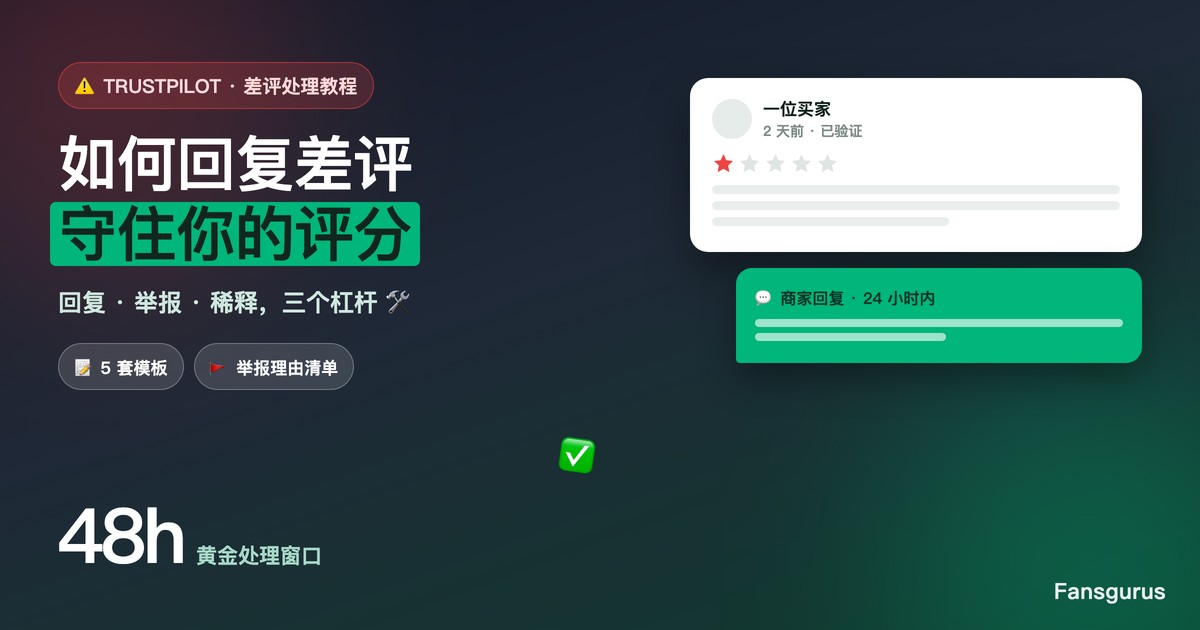
How to Respond to Negative Trustpilot Reviews and Protect Your Rating
Fansgurus Editorial Team
·
created at:2026-07-28 10:15:03
·
updated at:2026-07-28 10:15:03
article keywords tips:
#respond to negative trustpilot reviews
#how to reply to bad reviews
#trustpilot flag a review
#remove trustpilot review
#negative review response template
#protect trustpilot rating
Short answer: a reply does not change your TrustScore — the score is calculated from the 1-to-5 star ratings alone. What a reply changes is how the next shopper reads that one-star review, and that is worth more than most merchants think. You have exactly three levers against a negative review: reply to it (always), flag it (only on the specific grounds Trustpilot lists), and dilute it with newer reviews (because the score weights recent ones more heavily). There is no fourth lever, and the two things merchants reach for instead — arguing in public, or offering something in exchange for taking the review down — are both classified by Trustpilot as misuse.
This guide covers the 48-hour triage order, five reply templates you can paste and adapt, the exact list of valid flagging grounds, what happens after you flag, and the arithmetic for how many new reviews it takes to bring a rating back up.
1. Can replying actually bring my rating back up?
No — and knowing that precisely is what stops you wasting the first 48 hours on the wrong thing. Trustpilot states that the TrustScore is calculated solely on the basis of the 1-to-5 star ratings consumers give, weighted so that newer reviews count for more. A business reply is not an input to that formula.
What a reply does change is the read. A one-star review sitting alone says "this is what happens here". The same review with a specific, calm, non-defensive reply underneath says "this happened, and here is what they did about it" — and shoppers scanning your profile are reading the pattern, not the individual complaint. Sort the three levers before you act:
Lever
What it can do
What it cannot do
When to use it
Reply
Change how readers interpret the review; recover the customer
Move the TrustScore by itself
Every negative review, without exception
Flag
Get a genuinely rule-breaking review reviewed and possibly removed
Remove a review you simply disagree with
Only when it matches a listed ground (section 4)
Dilute
Actually move the score, because recent reviews weigh more
Work overnight, or fix the cause
Always, as the background process
So the honest sequencing is: reply today because it is free and it changes the read; flag only if it genuinely qualifies; and understand that the number itself only moves through new reviews arriving.
2. What should I do in the first 48 hours?
In this order. The order matters because step 1 changes what you write in step 3.
Verify it is your customer. Search the name, email or order reference in your own system. If you cannot match it to any transaction, note that — it changes both the reply and whether a flag is available to you.
Decide whether it is fixable. Late delivery, a faulty unit, a billing error: all fixable, and the reply should say so concretely. A mismatch of expectations is not fixable in the same way and needs a different reply.
Check it against the flagging grounds in section 4 — not against how unfair it feels.
Reply within 24–48 hours. Fast enough that the reader sees you are present, slow enough that you are not writing while annoyed. If you need a fact you do not have yet, reply anyway with what you know and what you are checking.
Log the root cause. Three one-star reviews about the same courier is not a review problem; it is an operations problem wearing a review costume.
One thing not to do in these 48 hours: do not contact the customer to ask them to change or delete the review once you have fixed their issue. That specific request is listed by Trustpilot as misuse of review invitations — more on why in section 5.
3. What does a good reply look like? Five templates
Trustpilot's own guidance is short: never argue, be brief, stay professional, keep personal information out, and finish on a positive note. Underneath that, every effective reply follows the same five-part shape:
Thank → name the specific problem → state the fact without defending → say what you have already changed → give one private channel.
Template 1 — Late or failed delivery
"Thanks for flagging this, [name]. Your order was due on [date] and arrived [x] days late — that is on us, not on you. The delay came from [specific cause], and since [date] we have moved [region] orders to [carrier/process] so it does not repeat. If the order is still unresolved, email [address] with your order number and we will sort it today."
Template 2 — Faulty or damaged product
"Sorry — a [product] that arrives like that is not what we ship. We have checked batch [x] and [what you found]. Replacement or refund, your choice: reply to [address] with your order number and we will process it the same day. Thank you for telling us; this is how we catch it."
Template 3 — Support was slow or unhelpful
"You waited [x] days for an answer and that is too long. Your ticket sat in [queue] because [reason], which we have since changed by [specific change]. I would like to finish this properly — [address] reaches me directly."
Template 4 — Expectation mismatch (the product did what it says, but not what they hoped)
"Thanks for the detail — it is useful. [Product] is built for [use case], and for [their use case] it will not do [x]; that is a real limitation, not a fault. We have made that clearer on the product page since. If you are inside the [x]-day window we will take it back, no argument: [address]."
Template 5 — You cannot find the transaction
"We take this seriously but we cannot locate an order under this name or email. If we have got the record wrong we want to fix it — send your order number to [address] and we will look immediately. If this review is about a different business, we would be glad to know that too."
Notice what none of the five do: no "we are sorry you feel that way", no paragraph of context before the acknowledgement, no counter-argument, no request to update the rating. The reader is not the reviewer — it is the shopper reading two weeks later, and that reader is grading your composure, not your case.
4. Which negative reviews can I actually flag?
Flagging is available free in the business account once you have claimed your profile, and Trustpilot publishes the grounds. A business may flag a review that:
attacks or uses derogatory or discriminatory language based on religion, ethnicity, nationality, race, colour, descent, gender or another identity factor;
intends to radicalise, spreads harmful propaganda, mobilises support for terrorism, or relates to violent extremism;
contains serious threats or threats of violence;
is likely to cause serious harm to someone's reputation or serious financial loss to a business;
includes a promotional code, a call to action, or advertises another business or unrelated product;
was written by someone not eligible to review you — an employee, a competitor, someone paid to write a fake review, or someone writing more than 12 months after their experience;
contains another person's personal information: a name, phone number, email address, or photos and videos of others.
Not valid grounds: disliking the star rating, or believing the review is unfair or overly critical. Trustpilot states plainly that it does not remove reviews just because a business thinks they are unfair.
What happens after you flag
A request goes to Trustpilot's Content Integrity team. The review stays visible during the investigation, except where it was flagged as harmful or illegal, which is hidden while assessed. If the reviewer needs to change something or supply documentation, Trustpilot contacts them and asks for action within three days. Complex cases take longer.
The trap: flagging is itself monitored
Misusing the flagging tool is not tolerated, and Trustpilot lists the patterns it treats as misuse — flagging negative reviews that do not breach the guidelines in an effort to get them removed; flagging the same review repeatedly; flagging content only when it appears in negative reviews (reporting a negative review that contains an employee's name while leaving an identical positive one alone); and flagging in bulk over a short period, which shows the content is being targeted by sentiment rather than checked for actual violations. The consequence ladder starts with a warning, then restricts the flagging function on your account, and can reach a Consumer Warning on your public profile. In short: flag consistently or do not flag at all.
5. What are the three things I must never do?
All three are listed in Trustpilot's Action We Take policy, and all three are things ordinary businesses do without realising.
Offering anything in exchange for removing or editing a review. Refunds, discounts, gifts, monetary rewards, loyalty points — all count as incentives, and attaching them to a review is prohibited.
Asking the customer to edit or delete the review after you have resolved their issue. This is the one that surprises people. Fixing the problem is right; then asking them to take the review down is explicitly listed as misuse. You can tell them it is fixed. You cannot ask for the review back.
Making resolution conditional on the review. "We will refund you once the review is down" is given by Trustpilot as an example of a business threatening a reviewer, and abuse toward the community is acted on quickly.
The workable version is simple: fix it, say publicly that you fixed it, and let the customer decide on their own whether to update anything. Reviewers can edit their own reviews whenever they want — many do, unprompted, once the problem is genuinely solved.
6. How many new reviews does it take to recover the rating?
This is the part that actually moves the number, so it deserves arithmetic rather than encouragement. Two mechanics drive it: newer reviews carry more weight, and Trustpilot seeds every profile with the equivalent of 7 reviews at 3.5 stars as a Bayesian starting point, which matters a lot when your review count is small.
A workable planning estimate — treating recent reviews as roughly equal and ignoring the decay of old ones, which makes this deliberately conservative — is: to lift a current average A across n reviews to a target T using new 5-star reviews, you need about n × (T − A) ÷ (5 − T) of them.
Your situation
Target
Roughly how many new 5-star reviews
50 reviews at 3.8
4.2
25
200 reviews at 3.8
4.2
100
200 reviews at 3.4
4.0
120
1,000 reviews at 3.9
4.3
570
Two things fall out of that table. First, the denominator is the whole story — the same half-star costs a mature profile five to ten times what it costs a young one, which is why "we will fix it later" is the expensive option. Second, every one of those new reviews has to come from somewhere: your invitation programme at its real response rate, which is what getting more reviews from real customers is about. If the volume your own invitations can produce in the time you have is short of the number in that table, the gap and its options are priced out in verified reviews vs organic invites, and the supplementary route runs at $8.5 per review on the Trustpilot service page. And if the score is falling rather than just sitting low, diagnose the cause first with why your TrustScore is dropping before you spend anything.
7. A 30-day plan after a bad review week
Days 1–2. Reply to every unanswered negative review, oldest first, using the templates above. Do not batch-flag anything yet.
Days 3–5. Cluster the complaints by cause. If one cause accounts for more than a third, that is the fix — not the reviews.
Days 6–7. Flag only the reviews that match a listed ground, one at a time, with the specific reason written out. Leave the rest.
Days 8–14. Ship the operational fix and say so in the replies you already posted, by editing them where the situation changed.
Days 15–30. Restore review inflow: unconditional trigger, reminders on, full quota. Compute the number from section 6, compare it with your monthly run-rate, and decide whether the timeline is acceptable before considering anything else.
Frequently Asked Questions
Q1: Does replying to a negative Trustpilot review improve my TrustScore?
A: No. The TrustScore is calculated solely from the 1-to-5 star ratings, weighted so newer reviews count for more, and a business reply is not part of that calculation. Replying is still worth doing on every negative review, because it changes how the next shopper reads the complaint and because it is often what recovers the customer. The score itself only moves when new reviews arrive.
Q2: Can I get a bad Trustpilot review removed?
A: Only if it breaches a listed ground. Businesses may flag reviews that contain discriminatory or threatening content, advertise another business, include someone else's personal information, or come from an ineligible reviewer such as an employee, a competitor, someone paid to write it, or someone writing more than 12 months after their experience. Disagreeing with the rating or finding it unfair is explicitly not a valid ground, and Trustpilot does not remove reviews on that basis.
Q3: What happens after I flag a review?
A: The flag goes to Trustpilot's Content Integrity team for assessment. The review stays visible while it is investigated, unless it was flagged as harmful or illegal, in which case it is hidden during the assessment. If the reviewer needs to amend the review or provide documentation, Trustpilot contacts them and asks for action within three days. Complex cases take longer. Note that flagging is monitored: flagging reviews in bulk, repeatedly flagging the same one, or only ever flagging negative reviews can get your flagging function restricted.
Q4: Can I ask a customer to delete their review after I have fixed the problem?
A: No. Trustpilot lists asking a customer to edit or remove a review after the business has resolved their issue as misuse, in the same category as offering incentives. Making a refund or resolution conditional on the review coming down is treated as a threat toward a reviewer. You can fix the problem and say publicly that it is fixed; the decision to update the review has to be the customer's own.
Q5: How many good reviews do I need to cancel out one bad one?
A: It depends entirely on how many reviews you already have. A usable planning estimate for lifting an average A across n reviews to a target T with new 5-star reviews is n × (T − A) ÷ (5 − T). Fifty reviews at 3.8 need about 25 new five-star reviews to reach 4.2; two hundred reviews at the same average need about 100; a thousand reviews at 3.9 need roughly 570 to reach 4.3. The larger your existing review count, the more expensive every half-star becomes.
📢 If you found this article helpful, feel free to share it with others: