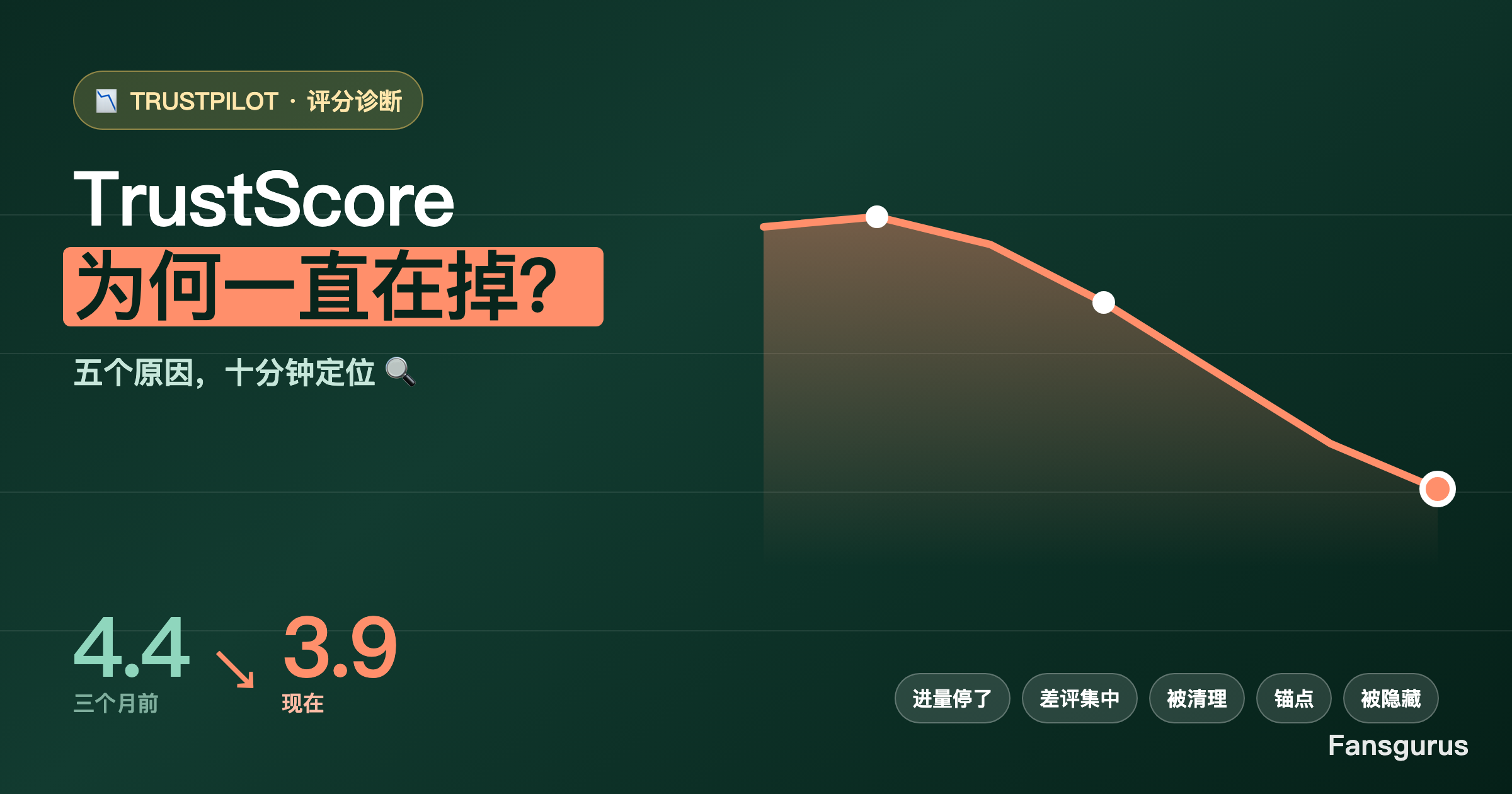
Why Is Your Trustpilot TrustScore Dropping? Common Causes and Fixes
Fansgurus Editorial Team
·
created at:2026-07-29 09:50:16
·
updated at:2026-07-29 09:56:20
article keywords tips:
#trustscore dropping
#why is my trustpilot score going down
#trustpilot rating dropped
#trustpilot reviews disappeared
#trustscore calculation
#recover trustpilot rating
Short answer: a falling TrustScore is almost never a penalty. In practice it is one of five things: your review inflow stopped (the score weights newer reviews more heavily, so silence alone pulls it down), a cluster of negatives landed, a batch of reviews was removed, your review count is small enough that the 3.5-star Bayesian anchor still dominates, or the score was hidden rather than lowered because of a compliance action. You can tell which one you have in ten minutes by comparing your review count and star distribution for the last 30 and 90 days against the same period before.
This guide gives you the symptom-to-cause table, the three checks that confirm each cause, the recovery arithmetic, and the rounding boundary that makes a score look like it dropped half a star when it moved by 0.01.
1. How is the TrustScore calculated? The one-minute version you need for diagnosis
You cannot diagnose a number you do not understand the shape of. Trustpilot publishes the essentials:
It is calculated solely from the 1-to-5 star ratings consumers give. Review text, your replies, your plan tier and your traffic are not inputs.
It is weighted so that newer reviews count for more than older ones. Trustpilot states that the most recent review holds the most weight, and that a score is more stable when reviews arrive regularly.
It starts from a Bayesian anchor. Every calculation includes the value of 7 reviews worth 3.5 stars, so a business with few reviews begins from a balanced position. As real reviews accumulate, that anchor becomes a smaller factor.
The star rating you see is the TrustScore rounded to the nearest half star using standard rounding rules.
Two consequences follow immediately, and they explain most "mystery" drops. First, doing nothing is not neutral — as your recent reviews age, their weight falls and the score drifts toward whatever is arriving now. Second, the displayed stars and the underlying score move on different schedules, so a visible half-star drop can correspond to a tiny change in the number. The full weighting model is broken down variable by variable in the Trustpilot rating algorithm guide.
2. Which of the five causes is yours?
Pull two numbers before you read this table: reviews received in the last 30 days and in the 30 days before that, plus the star distribution for each. Almost every diagnosis falls out of that comparison.
Symptom
Most likely cause
How to confirm
Score slides slowly, no new negatives, total count barely moving
Inflow stopped
Last 30 days is well below the previous 30; check whether invitations are still firing
Sharp drop over a few days, new 1- and 2-star reviews visible
Negative cluster
Read the complaints; if a third share one cause it is an incident, not a trend
Score fell and the total review count also fell
Reviews were removed
Compare today's total with a screenshot or an earlier export; check your inbox for notices from Trustpilot
You have under ~50 reviews and the score sits stubbornly near 3.8–4.2
The 3.5-star anchor still dominates
Your displayed score is visibly lower than your own average of the real reviews
The score is gone, not lower, and account features stopped working
Compliance action, not a drop
Look for a Consumer Warning banner on your public profile and for an email from Trustpilot
Note how different the last row is from the other four. A hidden TrustScore is not a scoring outcome at all; it is an enforcement outcome, and the recovery path is completely different — that one is covered in flagged reviews and compliance removals.
3. How do I confirm the inflow actually stopped?
This is the most common cause and the most commonly misread, because nothing looks broken. Three checks, in order:
Count, do not eyeball. Reviews received in the last 30 days versus the 30 before. A drop from 40 to 12 is your answer; you do not need to look further.
Check the pipe, not the page. Open your invitation settings. The usual culprits are an integration that silently disconnected after a platform update, a sending domain that started failing authentication, a quota exhausted early in the month by a bulk upload, or an automation whose trigger event was renamed.
Work out your maintenance rate. Ask what monthly volume holds your score steady. A rough working figure: a profile needs enough new reviews each month to be a visible share of its recent-weighted pool. In practice most merchants find stability somewhere around 3–5% of their total review count arriving monthly — below that the score drifts toward whatever trickles in, and complaints trickle in more reliably than praise.
That last point is the mechanism people miss: unhappy customers are self-motivated, happy ones need to be asked. When invitations stop, the mix of what still arrives skews negative on its own. The fix is not a campaign, it is restarting the pipe — the setup order is in getting more reviews from real customers.
4. A cluster of negatives landed. How long until the score recovers?
Long enough that you should calculate it rather than hope. Using the conservative planning estimate — new 5-star reviews needed ≈ n × (T − A) ÷ (5 − T), where n is your current review count, A your current average and T your target:
Current state
Target
New 5-star reviews needed
At 30 reviews/month
80 reviews at 3.6
4.0
32
about 1 month
300 reviews at 3.6
4.0
120
about 4 months
300 reviews at 4.0
4.3
129
about 4.5 months
1,200 reviews at 4.1
4.4
600
about 20 months
The recency weighting works in your favour here — real recovery is usually faster than this table, because the reviews that dragged you down lose weight as they age. But the table is the right one to plan with, because it tells you the honest order of magnitude, and because the last row is the important lesson: on a large profile, a rating you let slide is a rating you live with for a year or more. That is the argument for fixing inflow before the incident, not after.
Two things to do while the maths runs: reply to every negative in the cluster, because replies change how the cluster reads even though they do not touch the score (reply templates here), and fix the operational cause, because a cluster with a single shared cause will simply repeat.
5. My total review count went down. Were my reviews deleted?
Probably, and it is worth knowing why rather than guessing. Every review submitted to Trustpilot is checked by automated detection before it becomes visible, and the platform also sweeps retroactively — in 2024 it removed 4.5 million reviews, equal to 7.4% of everything submitted that year, with 90% of those caught automatically.
Removals fall into three buckets, and they need different responses:
Individual reviews removed after a flag. Someone reported it and the Content Integrity team agreed. Normal platform operation; nothing for you to do.
A batch removed by detection. If a group of reviews disappeared around the same date, the detection layer classified them together. Check your email — Trustpilot sends an educational email when it detects a pattern of misuse, before stronger action.
Removals tied to how you collected. If the removed reviews all came through one invitation route, the collection method is what got flagged, not the customers. Incentives, gated invitations, employee reviews and bulk sends are the usual causes.
The practical move is the same in all three cases: take a monthly snapshot of your total review count so you can tell a removal from a slowdown. Without that baseline, the two are indistinguishable and you will spend weeks fixing the wrong thing.
6. My score barely moved but I lost half a star. What happened?
Rounding. The displayed star rating is the TrustScore rounded to the nearest half star with standard rounding rules, so the boundaries sit at .25 and .75. A score moving from 4.25 to 4.24 changes the display from 4.5 stars to 4.0 stars — a visually dramatic drop caused by a hundredth of a point.
Two practical implications. First, do not panic-diagnose a half-star drop; check the underlying number before you conclude anything happened. Second, if you are sitting just above a boundary — 4.26, 3.76 — you are one bad week from a visible downgrade, and that is the moment to raise inflow rather than after you have crossed it. Knowing which side of the boundary you are on is worth more than knowing your score to one decimal.
7. A 60-day plan to stop the slide and turn it around
Days 1–3 — diagnose. Pull 30/90-day review counts and star distributions, compare with the previous periods, and identify which of the five causes matches. Check your public profile for a Consumer Warning banner and your inbox for anything from Trustpilot. Do not act before this is done.
Days 4–7 — stop the bleed. If inflow stopped, repair the integration and restart invitations today. If it is a negative cluster, reply to every one and identify the shared cause. If it is a removal, work out which collection route produced them.
Days 8–20 — fix the cause. Operational fix for a cluster; compliant invitation setup for a removal; unconditional trigger and reminders on in every case.
Days 21–45 — rebuild the rate. Get monthly inflow back to a level that is a meaningful share of your total count. Take a snapshot of the total each week from now on so the next incident is visible on day one.
Days 46–60 — verify. Recompute the number from section 4 against your actual monthly rate. If the timeline it implies is unacceptable for a campaign or a platform threshold you are working toward, that is the moment to look at the options priced in verified reviews vs organic invites — and not before, because buying volume on top of an unfixed cause simply buys the same problem again.
Frequently Asked Questions
Q1: Why is my Trustpilot TrustScore going down when I have no new bad reviews?
A: Because the score is weighted toward newer reviews, so a profile that stops collecting drifts downward on its own. As your recent positive reviews age, their weight falls, and the reviews that still arrive without being asked for skew negative — unhappy customers write unprompted, happy ones usually need an invitation. Compare your review count for the last 30 days with the 30 days before; if it dropped sharply, that is your cause, and the fix is restarting invitations rather than anything to do with the reviews themselves.
Q2: Does Trustpilot lower your score as a punishment?
A: No. The TrustScore is calculated from the 1-to-5 star ratings alone, weighted for recency, with a Bayesian anchor of 7 reviews at 3.5 stars included in every calculation. There is no penalty multiplier. What does exist is a separate enforcement outcome: when Trustpilot places a Consumer Warning on a profile for misuse, the TrustScore is hidden rather than reduced, paid features are switched off, and the account is limited to replying and flagging. A hidden score and a falling score are different problems with different fixes.
Q3: My total number of Trustpilot reviews went down. Why?
A: Reviews were removed. Every review is screened by automated detection before publication and the platform also sweeps retroactively — 4.5 million reviews were removed in 2024, 7.4% of all submissions that year, 90% of them automatically. Removals happen after a successful flag, as a batch caught by detection, or because of how a group of reviews was collected. Check your email for an educational notice from Trustpilot, and start taking a monthly snapshot of your total count so you can tell a removal from a slowdown next time.
Q4: How long does it take to recover a TrustScore?
A: Use n × (T − A) ÷ (5 − T) to get the number of new 5-star reviews needed, then divide by your monthly review rate. Eighty reviews at 3.6 need about 32 new five-star reviews to reach 4.0 — roughly a month at 30 reviews a month. Three hundred reviews in the same position need about 120, or four months. Twelve hundred reviews at 4.1 need around 600 to reach 4.4, which is well over a year. Recency weighting usually makes real recovery faster than this, but the arithmetic tells you the honest order of magnitude.
Q5: My score only moved 0.01 but I lost half a star. Is that a bug?
A: No, it is rounding. The star rating shown on your profile is the TrustScore rounded to the nearest half star using standard rounding rules, so the boundaries fall at .25 and .75. Moving from 4.25 to 4.24 flips the display from 4.5 stars to 4.0. If your score is sitting just above one of those boundaries, treat it as an early warning and raise your review inflow before a normal week pushes you across it.
📢 If you found this article helpful, feel free to share it with others: